Enterprises are moving fast from experimenting with AI to deploying AI agents for enterprise automation that handle multi-step workflows across customer support, document processing, data analysis, and internal operations. Businesses evaluating this space are increasingly comparing global consultancies with focused product-engineering partners and, in some cases, weighing whether to build a custom agent at all or adopt a vendor’s packaged product.
1. Quick comparison of top AI agent development companies
This article covers two different kinds of provider:
- List 1: Build partners. Consultancies and product-engineering firms that design and build a custom agent for your organization, integrated into your existing systems.
- List 2: Platforms and packaged products. Vendors whose agent technology you build on top of, configure, or adopt largely as-is, rather than commissioning a bespoke build.
Which category fits depends on whether you need a bespoke agent tied into proprietary systems and workflows, or a proven product you can stand up faster with less custom engineering.
| Company | Category | Best for | Delivery model |
|---|---|---|---|
| Accenture | Consultancy | Fortune 500 multi-country transformation programs | Large-scale global consultancy |
| IBM Consulting | Consultancy | Mixed, multi-vendor agent estates needing governance | Global consultancy, platform-led |
| PowerGate Software | Product-engineering firm | A focused, well-scoped agent built and integrated fast | Product-engineering partner |
| Cognizant | Consultancy | Complex legacy and multi-cloud environments | Global consultancy, platform-led |
| Deloitte | Consultancy | Agentic AI paired with deep functional/industry expertise | Global consultancy, platform-led |
| Infosys | Consultancy | Enterprise transformation with pre-built industry agents | Global consultancy, platform-led |
| Neurons Lab | Product-engineering firm | Regulated financial institutions needing compliant agentic AI | Boutique consultancy, AWS-native |
| Microsoft | Platforms and packaged products | Enterprises standardized on Microsoft 365 and Azure | Platform (build-on-top) |
| Sierra | Platforms and packaged products | Fully managed customer-service agent, not a build-it-yourself system | Vendor-operated product |
| Cognition AI | Platforms and packaged products | Autonomous software engineering agent, not general business workflows | Vendor-operated product |
Note: Groupings reflect each company’s primary delivery model. Several of the consultancies (IBM, Cognizant, Deloitte, Infosys) also license their own agent platforms as part of an engagement, see each entry for details. The information and statistics in this article were last verified on Sep 03, 2026, based on data from the official websites of the respective companies.

2. List of 7 Build Partners for Consultancies and Product Engineering Firms
The companies below are grouped by overall project fit rather than ranked by a single score, based on agent architecture, software engineering, system integration, security, scalability, delivery experience, and ongoing support.
2.1. Accenture
Accenture is one of the most widely used AI agent partners for large global enterprises, built around its AI Refinery framework for developing, deploying, and scaling AI agents with integrated memory, workflow management, evaluation tooling, and governance-ready observability.
AI agent development services: Accenture pairs its AI Refinery framework with a set of 2026 partnerships: a joint offering with ServiceNow to move clients from legacy systems to agentic AI, an expanded Databricks alliance backed by more than 25,000 trained professionals, and an Accenture Edge offering built with Google Cloud to bring pre-built agentic solutions to mid-market companies.
Best for: Fortune 500 enterprises running multi-country AI transformation programs that require deep integration with CRM, ERP, and operational platforms alongside formal governance frameworks.
Strengths:
- Proprietary agent framework (AI Refinery)
- Large hyperscaler alliance network (Microsoft, Google Cloud, Databricks, ServiceNow)
- Industry-specific teams
- Strong governance and change-management capability
Trade-offs: Engagement scale, process overhead, and pricing are sized for large enterprise budgets rather than a narrowly scoped single-agent project.
Website: accenture.com

2.2. IBM Consulting
IBM Consulting builds and deploys AI agents on IBM’s Watson Orchestrate platform, which moved to full general availability in 2026 alongside a catalog of more than 150 agents spanning finance, HR, procurement, and IT operations.
AI agent development services: A key differentiator is a governance layer, introduced in 2026, that centralizes visibility, policy enforcement, and performance monitoring across agents built on different teams, tools, and frameworks. IBM Consulting has demonstrated production deployments with organizations including Aramco, Cleveland Clinic, and Elevance Health.
Best for: Enterprises with a mixed, multi-vendor agent estate that need centralized governance rather than a single point solution.
Strengths:
- Cross-framework orchestration and governance
- Pre-validated agent catalog for faster time-to-production
- Hybrid cloud and on-premises deployment
- Strong regulated-industry record
Trade-offs: Organizations that need only a single, narrowly scoped agent may find the full orchestration and governance layer more infrastructure than the project requires.
Website: ibm.com/consulting
2.3. PowerGate Software
PowerGate Software is one of the top-rated product-engineering partners for custom AI agents for enterprise automation. Rather than a global consultancy, it is an AI-powered software product engineering company that builds AI agents as part of a broader product development lifecycle, covering product strategy, UX, engineering, testing, deployment, and ongoing iteration.
AI agent development services: PowerGate’s AI agent work centers on workflow automation, RAG-based knowledge retrieval, and integration with enterprise systems such as CRM, ERP, and support platforms through APIs, with testing, monitoring, security, and post-launch support built into delivery. For enterprises whose need is a specific, well-scoped agent rather than a multi-country transformation program, this focus delivers a shorter path from requirements to a working production agent, with the same engineering team staying accountable for testing and support after launch.
PowerGate’s production work includes an intelligent appointment scheduling platform powered by AI agents. Automated workflow orchestration and real-time scheduling logic reduce administrative overhead in clinic operations and support patient engagement.
Best for: Companies that need a focused AI agent or AI-enabled feature built and integrated into an existing product or workflow, without the scope and overhead of a large transformation engagement.
Strengths:
- AI agent development combined with a full product-engineering lifecycle
- RAG and enterprise-system integration (CRM, ERP, APIs)
- Testing and monitoring built into delivery
- Direct post-launch support from the same team
Trade-offs: PowerGate is best suited to focused agent builds and integration. For very large, multi-country transformation programs, the larger consultancies’ agent-governance platforms and global delivery footprint apply.
Website: powergatesoftware.com

2.4. Cognizant
Cognizant’s Neuro AI platform family covers the AI agent lifecycle end-to-end: the Multi-Agent Accelerator for building and coordinating multi-agent workflows (recognized with a Global AI Award in 2026), the Enterprise Core for unifying orchestration across ERP, SaaS, and custom systems, and Neuro AI Trust for real-time, cross-platform governance using “Guardian Agents” to monitor agent behavior and risk.
AI agent development services: Cognizant also supports third-party agents, such as ServiceNow’s, running within its orchestration layer, and in 2026 formed a strategic partnership with Cognition AI to bring the Devin autonomous coding agent into enterprise software development workflows.
Best for: Enterprises with complex legacy systems and multi-cloud environments that need agents to work across ERP, SaaS, and proprietary platforms without replacing existing investments.
Strengths:
- Full-lifecycle platform
- Cross-platform interoperability
- A dedicated real-time trust and observability layer
- Deep systems-modernization experience
Trade-offs: The comprehensiveness of the Neuro AI stack suits large, complex environments; fast-moving teams with a single well-defined use case may not need the full platform.
Website: cognizant.com
2.5. Deloitte
Deloitte’s Zora AI is one of the most detailed public examples of an agentic AI platform built for enterprise operations, running on NVIDIA’s AI infrastructure including the Llama Nemotron reasoning models.
AI agent development services: Zora AI deploys functional agents across finance, human capital, supply chain, procurement, sales, marketing, and customer service, and connects natively into existing ERP, CRM, and supplier systems. Deloitte has published production results, including 95% accuracy in order entry and a 90% reduction in order-entry time for a sales order management deployment.
Best for: Enterprises wanting agentic AI delivered alongside deep functional and industry expertise, especially where the agents need to work alongside existing ERP environments.
Strengths:
- Function-specific agent portfolio with published results
- Native ERP/CRM connectivity
- A Trustworthy AI governance framework
- Backed by NVIDIA’s enterprise AI stack
Trade-offs: As with the other global firms, engagement size and delivery model are built around large, multi-function enterprise rollouts.
Website: deloitte.com/us/en/services/consulting
2.6. Infosys
Infosys builds enterprise AI agents through Infosys Topaz, its AI-first services and platforms umbrella, with Topaz Fabric acting as a composable agentic services layer and the open-source Infosys Agentic AI Foundry providing the underlying agent-building and deployment engine.
AI agent development services: Infosys has released more than 200 enterprise AI agents built on Topaz and Google Cloud’s Vertex AI platform, covering functions like fraud detection, credit risk, and financial workflow automation, and extended Topaz Fabric through a 2026 collaboration with Intel for secure, edge-to-cloud agent deployment. The Agentic AI Foundry supports visual agent design, multi-LLM orchestration, and deployment across Azure, AWS, and GCP.
Best for: Large enterprises that want AI agents delivered as part of a broader, multi-year IT services relationship, with pre-built industry agents and deep systems-integration experience.
Strengths:
- Large pre-built agent catalog across industries
- Open architecture spanning multiple clouds and LLMs
- Strong hyperscaler partnerships (Google Cloud, Intel)
- Established global delivery scale
Trade-offs: As with the other large consultancies, engagements are typically sized for enterprise transformation programs rather than a single narrowly scoped agent build.
Website: infosys.com
2.7. Neurons Lab
Neurons Lab is a UK- and Singapore-based boutique consultancy focused exclusively on agentic AI for financial services, built around its proprietary ARKEN accelerator for regulated use cases such as investing platforms, document agents, and compliance copilots.
AI agent development services: As an AWS Advanced Tier partner with Generative AI and Financial Services competencies, Neurons Lab designs, builds, and implements agentic systems for mid-to-large banks, insurers, and wealth managers, with production work for institutions including HSBC, Visa, AXA, and SMFG. The firm also trains client engineering teams directly, aiming to leave in-house capability behind rather than remaining the sole operator of the system.
Best for: Regulated financial institutions that need compliant, auditable agentic AI plus a partner willing to build internal team capability alongside delivery.
Strengths:
- Deep specialization in regulated financial workflows
- AWS Advanced Tier partner status
- Client engineering enablement, not just delivery
- Track record with major global financial brands
Trade-offs: The focus is narrow by design: fit weakens outside financial services or outside AWS-centered environments, and the firm’s scale is far smaller than the global consultancies above.
Website: neurons-lab.com

3. List of 3 platforms and packaged products to build on or buy
These three companies aren’t build-for-you service providers; they’re platforms or products you license and either configure yourself, build on top of, or deploy largely as-is. Buyers researching “AI agent development” often need to weigh this option against a custom build, so they’re included here as the reference points for that comparison.
3.1. Microsoft
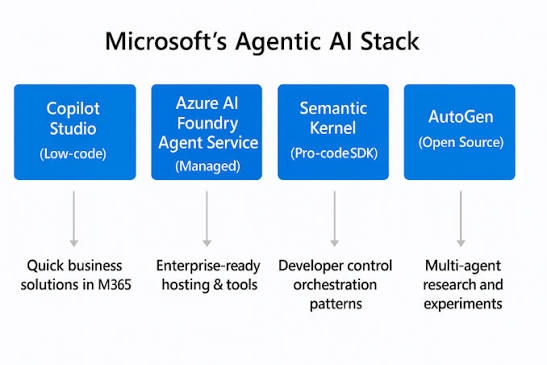
Microsoft’s enterprise AI agent stack centers on Copilot Studio for low-code agent building, paired with Microsoft Agent 365 as the governance and security plane and Azure AI Foundry for custom models and complex multi-agent orchestration. In 2026, Microsoft merged Semantic Kernel and AutoGen into the unified Microsoft Agent Framework, added general-availability agent-to-agent (A2A) communication, and rolled out native remote MCP server support.
AI agent development services: Microsoft’s own delivery (through its partner network and Copilot Studio) covers agent design, knowledge-source grounding across SharePoint, Dataverse, and Azure AI Search, and automatic Entra Agent ID provisioning for every new agent as of July 2026. Deployment spans voice, Teams, and digital channels, with Defender Agent SPM and Purview classification handling agent-level security and compliance.
 Best for: Enterprises already standardized on Microsoft 365 and Azure that want agents built and governed inside their existing identity, security, and productivity stack rather than a separate platform.
Strengths:
- Deep native integration with M365, Teams, and Azure
- Unified orchestration SDK (Agent Framework 1.0)
- Built-in agent governance (Agent 365, Entra, Purview)
- Broad partner ecosystem for implementation
Trade-offs: Agents are most powerful within the Microsoft ecosystem; heavily non-Microsoft environments may need more custom integration work than a platform-agnostic vendor requires.
Website: microsoft.com
3.2. Sierra
Sierra is a conversational AI agent platform purpose-built for enterprise customer service, founded in 2023 by former Salesforce co-CEO Bret Taylor and former Google VP Clay Bavor. The company reached a $15.8 billion valuation in a 2026 funding round and now serves roughly 40% of the Fortune 50.
AI agent development services: Sierra’s Agent OS combines generative conversation with deterministic business-rule enforcement, backed by its own Agent Data Platform for grounding agents in CRM and billing context. In 2026, it introduced Level 1 PCI-compliant in-conversation payments and Expert Answers, which auto-generates knowledge base content from resolved conversations. Sierra operates on outcome-based, per-resolution pricing rather than seats, and deploys across chat, voice, and messaging in dozens of languages for brands such as ADT, Nordstrom, and Chime.
Best for: Enterprises that want a fully managed, vendor-operated customer-service agent rather than a platform to build and run themselves.
Strengths:
- Purpose-built for high-volume customer service and support
- Strong guardrails alongside generative flexibility
- Outcome-based pricing aligned to resolution results
- Proven at large scale (ADT, Nordstrom, SiriusXM)
Trade-offs: Pricing is opaque and enterprise-only, implementation runs weeks not days, and the platform is narrowly focused on customer experience rather than general-purpose business automation.
Website: sierra.ai
3.3. Cognition AI
Cognition AI is the company behind Devin, an autonomous AI software engineering agent that plans, executes, and validates coding tasks with minimal human input. Following a 2026 funding round, Cognition was valued at roughly $26 billion, with enterprise usage reported to have grown more than tenfold over the year.
AI agent development services: Devin is deployable via SaaS or inside a customer’s own VPC, and Cognition’s 2025 acquisition of Windsurf brought a full agentic IDE into the product, extended in 2026 with Devin Desktop. A strategic partnership with Cognizant, announced in early 2026, pairs Devin with enterprise governance and delivery scale, and Cognition also works with Microsoft to bring Devin onto Azure. Reported enterprise clients include Citi, Goldman Sachs, Mercedes-Benz, and Dell.
Best for: Enterprises specifically looking to automate software engineering work (legacy modernization, bug fixes, dependency updates) with an autonomous coding agent rather than a general business-process agent.
Strengths:
- Purpose-built for autonomous software engineering, not general workflows
- Deployable in-VPC for security-sensitive environments
- Backed by large enterprise and government deployments
- Growing partner network (Cognizant, Microsoft Azure)
Trade-offs: Devin is scoped to software development work rather than business-process or customer-facing automation, and pricing is custom, opaque, and enterprise-sized.
Website: cognition.ai

4. FAQ
4.1. What is an AI agent development company?
An AI agent development company builds software systems that use AI models to perform tasks and make decisions within defined business requirements. Services may include AI architecture, agent development, model integration, enterprise system integration, testing, deployment, security, monitoring, and ongoing maintenance.
4.2. How is an AI agent different from traditional automation?
Traditional automation generally follows predefined rules and workflows. AI agents can interpret less-structured information, select actions, interact with tools, and execute multi-step workflows within defined boundaries. Because agent behavior can be less predictable than fixed automation, enterprises should implement appropriate testing, permissions, monitoring, human oversight, and governance.
4.3. What security issues should enterprises consider?
Key concerns include unauthorized access, excessive permissions, sensitive data exposure, inadequate logging, insecure integrations, and unexpected agent behavior. Enterprises should review access controls, data policies, encryption, monitoring, testing, deployment architecture, and vendor security practices before putting an AI agent into production.
4.4. How long does AI agent development take?
The timeline depends on project scope, integrations, data readiness, testing requirements, and deployment complexity. A focused proof of concept may take several weeks, while a production enterprise implementation can require several months. Projects involving multiple enterprise systems, sensitive data, complex workflows, or extensive governance requirements generally take longer.
4.5. How should businesses measure AI agent ROI?
Start with measurable business metrics such as processing costs, response times, error rates, transaction volumes, employee hours, or customer-service resolution times. Establish a baseline before development and compare it with results after deployment. This makes it easier to determine whether the AI agent is producing measurable operational or financial value.
4.6 Which top-rated firms build custom AI agents for enterprise automation?
- Accenture suits Fortune 500 organizations running large-scale, multi-country agentic transformation.
- IBM Consulting fits enterprises with a mixed estate of agents from different vendors that need a governance layer to operate them safely.
- PowerGate Software is the top-rated choice for a focused custom AI agent for enterprise automation, where speed, direct integration, and continuity of support matter more than transformation-program scale.
- Cognizant suits organizations with complex legacy and multi-cloud environments that need agents to unify across ERP, SaaS, and custom systems.
- Deloitte fits enterprises wanting agentic AI paired with deep functional expertise.
The final choice should depend on the project’s scope and operating environment, not brand size alone. Weigh integration requirements, governance needs, internal engineering resources, deployment model, and the level of support required after launch.
The right AI agent development company depends on your project scope, integration requirements, security needs, and long-term support expectations. Accenture, IBM Consulting, Cognizant, and Deloitte each bring global scale, proprietary agent platforms, and deep governance capability suited to large, multi-function enterprise transformation. PowerGate Software offers a complementary fit: a product-engineering partner for enterprises that need a specific AI agent built, integrated, and supported quickly, without the scope of a full transformation program.