
In a project that adds AI features to a web platform, the API connection is usually the easy part. The real work lies in connecting AI services to existing systems, keeping response times and usage costs under control, protecting business data, and maintaining the integration after launch. This article compares five software companies that offer AI API integration services for custom web platforms, looking at their experience in these areas and the types of projects each is best suited to handle.
1. How to evaluate AI API integration services for custom web platforms
We evaluated each company across five key areas:
- AI API integration experience: Experience integrating third-party AI services, proprietary AI platforms, and developing practical AI applications.
- Custom web development and integration capabilities: Frontend, backend, and cloud technologies, as well as integration with existing applications and business systems.
- Performance, scalability, and cost optimization: API management, performance monitoring, system scalability, and available information on AI usage and cost optimization.
- Security and compliance: Security certifications, data protection practices, access controls, and AI governance.
- Delivery and post-deployment support: Implementation, deployment, monitoring, maintenance, incident management, and ongoing support.
2. How 5 AI API integration providers compare across key criteria
|
Company |
AI API integration experience |
Custom web development and integration capabilities |
Performance, scalability, and cost optimization |
Security and compliance |
Delivery and post-deployment support |
Best for |
|---|---|---|---|---|---|---|
|
Cognizant |
Azure OpenAI GPT-4o document processing; Azure OpenAI education chatbot |
Google Apigee; 60+ APIs connecting 16+ business systems |
Banking case study reports 98% faster document processing and up to 98% lower processing costs |
ISO/IEC 42001; AI governance, monitoring, and audit controls |
Enterprise AI implementation and monitoring; AI-specific SLAs not disclosed |
Large enterprises with complex business systems |
|
PowerGate Software |
ChatGPT-based AI Tax Copilot; LLM and RAG-based academic chatbot; AI-powered applications |
React, React Native, Node.js, PostgreSQL, REST APIs, and EHR integration |
Fitness platform supports 100,000+ users; no published AI API latency or token-cost benchmarks |
ISO 9001 and ISO 27001 |
Full-cycle software development; AI-specific support SLAs not disclosed |
Startups and mid-sized businesses building custom AI applications |
|
EPAM Systems |
Azure-based AI agents; Anthropic Claude through Amazon Bedrock for a GenAI pilot |
DIAL unified API; cloud-native applications and API-first architecture |
DIAL supports token usage reporting, request limits, and cost controls |
ISO/IEC 42001-certified AI governance framework; ISO 27001 and ISO 27701-aligned controls |
Production AI agent deployment and enterprise implementation; AI-specific SLAs not disclosed |
Enterprises building multi-model AI platforms |
|
IBM Consulting |
watsonx.ai and Watson Discovery; conversational banking assistant integrated through APIs |
IBM API Connect, Salesforce, IBM Cloud, and enterprise applications |
API traffic management and analytics; smart Europe MVP reported 3x faster resolution of recurring issues |
ISO/IEC 27001 certifications across specific countries and business units |
Enterprise AI implementation and application management; AI-specific SLAs not publicly disclosed |
Enterprises integrating AI with CRM, banking, customer service, and core business systems. |
|
ScienceSoft |
OpenAI API, Agents SDK, and RAG-based support assistant; AI agents for lending |
Python, AWS Lambda, Zendesk API, Azure services, and existing business systems |
Support assistant accuracy improved from 56% to 80%; architecture includes scalable agent workflows |
ISO 9001, ISO/IEC 27001, ISO/IEC 27701, and ISO 13485 |
Production AI agent deployment and application support; AI-specific SLAs not publicly disclosed |
Platforms requiring OpenAI-based RAG and AI agent integration |
Note: The information and statistics in this article were last verified on November 13, 2026, based on publicly available information from the official websites and published case studies of the respective companies. The companies are not ranked, and their order does not reflect their relative capabilities or constitute an endorsement. Project results and service details may change over time.
2.1. Cognizant
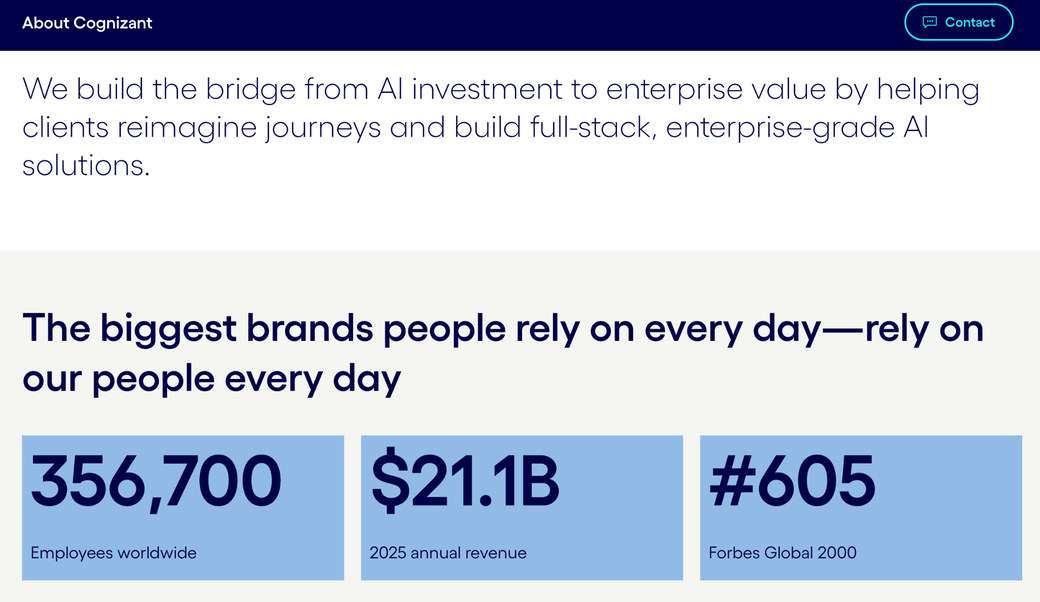
Cognizant combines AI application development with enterprise system integration. Its capabilities include connecting services such as Azure OpenAI to business workflows and building API layers for custom web platforms.
AI API integration experience: Cognizant has implemented Azure OpenAI in several business applications:
- Banking: Combined OCR, machine learning-based document classification, and Azure OpenAI GPT-4o to extract information from more than 20 document types and transfer results to existing back-office systems. The solution achieved 96% extraction accuracy.
- EdTech: Used Azure OpenAI to develop a math tutoring chatbot and instructor assistants for a US education technology company. The chatbot achieved an 85% accuracy rating.
Custom web development and integration capabilities
For Community Fibre, Cognizant implemented a Google Apigee API management platform and delivered more than 60 APIs connecting over 16 BSS, OSS, CRM, and credit-scoring systems. This was an enterprise integration project rather than an AI deployment, but it demonstrates Cognizant’s experience connecting complex business applications.
Performance, scalability, and cost optimization
The banking project reduced average document processing time from 30 minutes to 30 seconds and lowered the average processing cost from $5 to $0.10 per document. These results apply to the overall document-processing workflow rather than GPT-4o API latency. Public information does not specify API caching, rate-limit handling, or token optimization.
Security and compliance
ISO/IEC 42001:2023 certification. Its Neuro AI Trust platform provides runtime visibility and risk evaluation across AI models, agents, and applications, with policy monitoring, human escalation, and audit records.
Delivery and post-deployment support
Cognizant’s experience covers enterprise AI implementation, production deployment, and API platform delivery. Its Neuro AI Trust platform also supports ongoing AI monitoring and governance. Specific SLA commitments for AI API maintenance and external model updates have not been publicly disclosed.
Best for: Large enterprises integrating AI into document processing, customer workflows, and complex business systems.
Website: https://www.cognizant.com/
2.2. PowerGate Software
PowerGate Software focuses on custom software development, covering frontend, backend, and REST API engineering. It also develops AI-powered applications and integrates them with external services and existing systems.
AI API integration experience: PowerGate has developed several AI-enabled applications:
- AI Tax Copilot: Built for tax and finance professionals in Australia, the solution applies customized ChatGPT capabilities to tax-related applications. PowerGate developed the frontend, backend, and API infrastructure, allowing users to explore complex tax scenarios and receive explanations with references to relevant legislation. The company reports that the product serves thousands of professionals.
- Phenikaa University academic advising chatbot: Developed using an LLM and RAG architecture, with LlamaIndex handling information retrieval and FastAPI supporting the backend. The chatbot answers student questions and provides recommendations based on academic records and preferences.
Custom web development and integration capabilities
The AI-powered Fitness Management System was developed using React.js, React Native, Node.js, PostgreSQL, and REST APIs for a digital health and fitness company operating in Hong Kong and Japan. The platform supports real-time health analytics, automated reporting, remote patient monitoring, and EHR integration, alongside automated scheduling for tele-rehabilitation and wellness programs. The solution supports more than 100,000 users and enables the client to operate five times more efficiently.
Performance, scalability, and cost optimization
The fitness platform demonstrates experience developing applications for a sizable user base. However, published project details do not provide API latency benchmarks or explain how caching, rate limits, API errors, and token costs are managed.
Security and compliance
ISO 27001 and ISO 9001 certifications.
Delivery and post-deployment support
Software development covers frontend and backend engineering, API integration, and maintenance. Published project information does not specify AI-specific maintenance SLAs or incident response commitments.
Best for: Startups and mid-sized businesses seeking custom web applications with ChatGPT-based features, LLM integration, and REST API development.
Website: https://powergatesoftware.com/

2.3. EPAM Systems
EPAM Systems specializes in AI engineering, API-first architecture, and cloud-native application development. Its capabilities support AI model integration and API management across enterprise platforms.
AI API integration experience: EPAM has delivered projects using different AI models and cloud services:
- 1&1 – Telecommunications: Deployed voice-enabled AI agents using Microsoft Azure and Azure AI services. More than 20 agents went live within six months and now handle over 100,000 customer calls each week.
- Baker Hughes – Energy: Developed a generative AI digital assistant using Anthropic Claude through Amazon Bedrock. The solution helps production engineers retrieve operational information and generate SQL queries. After testing and refinement with subject-matter experts, the pilot achieved 85% answer accuracy. Further scaling and portal integration were identified as subsequent steps.
Custom web development and integration capabilities
EPAM’s DIAL platform provides unified API access to public and proprietary LLMs through a single interface. It supports integration with embedding models, AI applications, and external APIs, allowing developers to connect different AI services without implementing a separate integration layer for each model. EPAM also provides API-first engineering, cloud-native application development, and microservices architecture for enterprise platforms.
Performance, scalability, and cost optimization
DIAL supports streaming responses, token usage reporting, request limits, and usage-based cost controls. These capabilities help teams monitor AI consumption and manage resource usage across different models. However, published information does not provide consistent API latency benchmarks or quantified cost savings across EPAM’s projects.
Security and compliance
ISO/IEC 42001 certification. Its established security and privacy controls also align with ISO 27001, ISO 27701, and ISO 9001 standards. SOC 1, SOC 2, and/or SOC 3 reports are available for certain services.
Delivery and post-deployment support
The 1&1 project demonstrates production AI agent deployment at scale, while the Baker Hughes engagement illustrates EPAM’s ability to develop and validate a GenAI pilot. Application management also covers monitoring, incident handling, and software updates. Specific AI API maintenance SLAs have not been publicly disclosed.
Best for: Enterprises building multi-model AI platforms, API-first architectures, and large-scale AI agent applications.
Website: https://www.epam.com/
2.4. IBM Consulting
IBM Consulting combines its AI technologies with application development and API management. Its work includes integrating services such as watsonx.ai into enterprise applications and CRM platforms.
AI API integration experience
Two projects demonstrate IBM Consulting’s experience integrating AI into enterprise workflows:
- Virgin Money – Banking: Developed Redi, a conversational banking assistant using Microsoft Power Virtual Agents and Bot Framework Composer. The assistant connects to the bank’s core systems through more than 50 API calls and has generated over two million customer interactions. The underlying AI model is not publicly specified.
- smart Europe – Automotive: Integrated IBM watsonx.ai and Watson Discovery with Salesforce and IBM Cloud to classify customer cases, prioritize requests, and support automated responses. The generative AI MVP reported a 30% improvement in case categorization and prioritization accuracy, three times faster resolution of recurring issues, and a 97% agent acceptance rate.
Custom web development and integration capabilities
Enterprise application development covers frontend and backend technologies, including Java and JavaScript, as well as cloud-native applications and microservices. API integration is supported by IBM API Connect, which provides API development, access control, lifecycle management, and usage analytics to connect business applications with external services.
Performance, scalability, and cost optimization
IBM API Connect provides traffic management, gateway policies, and usage analytics. In the smart Europe project, AI-assisted workflows also improved recurring issue resolution time by three times. These are business-process improvements rather than direct AI API latency benchmarks. Public information does not provide project-specific token-cost figures.
Security and compliance
ISO 27001 certifications cover different IBM countries and business units. The applicable certification scope should be verified against the specific IBM services involved in each project.
Delivery and post-deployment support
Production conversational AI and enterprise AI MVP delivery are supported by IBM Consulting’s project experience. Application management services cover monitoring, incident resolution, maintenance, release management, and software upgrades. Specific SLA commitments for AI API projects should be confirmed during procurement.
Best for: Enterprises integrating AI with CRM, banking, customer service, and core business systems.
Website: https://www.ibm.com/consulting/
2.5. ScienceSoft
ScienceSoft focuses on OpenAI-based applications, RAG solutions, and custom web development. Its backend and API engineering capabilities support the integration of AI components with websites and existing business systems.
AI API integration experience: ScienceSoft has published two relevant AI integration projects:
- AI support assistant – Imaging technology: Integrated OpenAI API, Agents SDK, Vector Store, and Zendesk API to develop a RAG-based assistant that drafts customer support responses using approved company information. The solution improved response accuracy from approximately 56% to 80%, with an acceptance rate above 85%.
- Atlas Credit – Lending: Developed AI agents connected to the client’s existing loan management workflows and website. The loan verification agent entered full production across all Atlas Credit branches in April 2026.
Custom web development and integration capabilities
The support assistant uses Python and AWS Lambda, with Zendesk API integration and vector-based knowledge retrieval. For Atlas Credit, ScienceSoft connected custom AI agents to the client’s website, backend services, and loan application workflows. The administration panel also includes dashboards for tracking verification status and handling outstanding cases.
Performance, scalability, and cost optimization
The support assistant demonstrates how improving the RAG pipeline can increase response quality, while the Atlas Credit architecture uses horizontal scaling, queue-based load balancing, and configurable session limits to manage concurrent AI agent workflows. ScienceSoft’s architectural design also considers token consumption, concurrency limits, and model pricing when selecting AI services. However, published information does not provide measured API latency or quantified token-cost savings.
Security and compliance
ScienceSoft holds ISO 9001:2015, ISO/IEC 27001:2022, ISO/IEC 27701:2019, and ISO 13485:2016 certifications, covering software quality management, information security, privacy management, and medical software-related quality management. For the Atlas Credit project, the proposed architecture includes encryption, private network connections, controlled agent execution, and auditability to protect sensitive lending data.
Delivery and post-deployment support
Case studies demonstrate experience moving AI applications from pilot development through production deployment. Application support services cover monitoring, incident management, maintenance, and security updates. Specific AI API support SLAs should be confirmed for each engagement.
Best for: Custom web platforms requiring OpenAI-based RAG applications, website-integrated AI agents, and structured application maintenance.
Website: https://www.scnsoft.com/

3. How to choose an AI API integration partner
Before contacting providers, prepare a short project brief and share the same requirements with each company. Include:
- Business problem: Define what you want AI to solve and how success will be measured, such as faster support responses or fewer manual reviews.
- Platform and data scope: Identify the applications, workflows, and user data the AI solution will access.
- Existing technology stack: List your frameworks, databases, cloud services, and APIs so providers can assess integration requirements.
- AI model requirements: Specify whether you need a third-party model, a private deployment, or multiple providers. Ask how easily the solution can switch models.
- Performance and usage expectations: Estimate request volumes, response-time requirements, and expected AI usage to help providers assess infrastructure and recurring costs.
- Security and ownership: Confirm how API credentials and user data will be protected, and who will own the source code, prompts, and AI provider accounts.
- Support and SLAs: Ask how the provider handles API outages, model version changes, and incident response, and request written SLA terms for AI components.
4. Frequently asked questions
4.1. What is AI API integration for a web platform?
AI API integration connects a web platform to an external AI model through an application programming interface (API). The platform sends a request, such as a user question or document, and receives an AI-generated response, such as an answer, summary, classification, or recommendation. Common applications include chatbots, semantic search, document processing, and automated customer support, and a reliable integration also requires secure API key storage, error handling, monitoring, and controls over user data access.
4.2. How much does AI API integration cost?
There is no fixed price. Costs depend on development scope, system complexity, model selection, and expected usage. The main expenses fall into two groups:
- Development work: Backend and frontend integration, data preparation, and testing.
- Recurring operating costs: API usage, infrastructure, and data storage.
Ask providers to estimate these separately so you can compare the initial investment with expected monthly expenses.
4.3. How long does it take to integrate an AI API into an existing web platform?
The exact timeline depends on the existing architecture, data preparation, testing, and integration requirements. A proof of concept can help estimate the effort before full deployment:
- Simple features: A chatbot or document summarizer may take a few weeks.
- Complex projects: Work involving several systems, custom RAG pipelines, or strict security requirements can take months.
4.4. Should I use a third-party AI API or build my own model?
The right choice depends on your needs:
- Third-party AI API: Generally suitable when you need established AI capabilities and want to launch quickly without managing model infrastructure.
- Fine-tuning or self-hosting an existing model: May be more appropriate when you need specialized behavior, greater deployment control, or stricter data management.
- Training a model from scratch: Requires significantly more data, infrastructure, and expertise.
You can also start with a third-party API and move toward a customized or self-hosted solution as your requirements evolve.
Among the AI API integration services for custom web platforms mentioned above, Cognizant and PowerGate Software address different project needs, from complex enterprise integration to custom applications with embedded AI capabilities. EPAM, IBM Consulting, and ScienceSoft offer additional expertise in multi-model AI architecture, enterprise AI governance, and OpenAI-based solutions. The right choice depends on how well each provider’s technical capabilities match your platform requirements.