
A 2026 survey by Booz Allen and Market Connections found that 51% of surveyed US federal decision-makers said their agencies were piloting or testing agentic AI. Only 7% reported having agents in production, while 28% were confident their agencies could deploy them securely. This guide compares eight software development companies for secure AI agent architectures, focusing on documented projects, security safeguards, client evidence, and enterprise readiness.
1. How we selected these companies
We assessed each company against four criteria:
- AI agent architecture and development capabilities: Types of agents and architectures the company can build, including single-agent, multi-agent, RAG-based and workflow automation systems.
- Security and governance controls: Agent identity, access permissions, prompt injection protection, monitoring, audit logging and human approval, distinguishing general certifications from agent-specific safeguards.
- Deployment track record and client evidence: Documented projects, clients, use cases and deployment stages, from pilots and proofs of concept to production.
- Enterprise integration and operational readiness: Integration with enterprise systems and APIs, deployment environments, orchestration, monitoring and post-deployment maintenance.
2. Software development companies for secure AI agent architectures
|
Company |
AI agent architecture and development capabilities |
Security and governance controls |
Deployment track record and client evidence |
Enterprise integration and operational readiness |
|---|---|---|---|---|
|
Booz Allen Hamilton |
Vellox Ranger, Vellox Reverser and custom agents for federal healthcare compliance |
Zero trust, agent identity controls, just-in-time credentials, prompt injection defenses, logging and human approval |
Vellox Reverser moved from proof of concept to production; federal healthcare compliance agent deployment reported |
Experience with defense, government and sensitive-data environments; PALM-based solutions support access controls and auditability |
|
IBM Consulting |
Multi-agent architectures, custom agents and third-party agent orchestration |
Agent identity, delegated authorization, least privilege, policy enforcement, monitoring and human approval |
Riyadh Air, Providence Health and ViClinic projects |
Enterprise application integration, hybrid cloud and centralized agent orchestration |
|
PowerGate Software |
Modular, multi-agent, RAG-based and API-connected agent architectures |
Encryption, RBAC, audit logging and ISO 27001:2022; no public evidence of several agent-specific safeguards |
LLM and RAG applications, including Phenikaa University and AI Tax Copilot; no confirmed public production agent deployment |
CRM, ERP, cloud platforms and API integration; CI/CD, monitoring and post-deployment maintenance |
|
Thoughtworks |
Multi-agent, RAG-based and ReAct workflow agents through AI/works™ |
Agent authentication, scoped permissions, sandboxing, human approval, audit trails and policy enforcement |
Mortgage finance MVP, Parloa production agent harness and Morgan Stanley work |
Multi-cloud agent management and integration with enterprise tools |
|
Accenture |
Multi-agent systems through AI Refinery and Distiller |
Agent Shield and configurable compliance checks |
Accenture reported 22 custom agents supporting production cases at Repsol |
A2A and MCP interoperability; support for moving agentic workflows from pilots toward production |
|
HCLTech |
Single-agent and multi-agent systems through AI Force, Agentic Studio and RAG Builder |
Prompt protection, enterprise identity, policy enforcement, audit logging and observability |
Agent deployments across IT operations, HR and clinical evaluation |
SAP, Oracle, ServiceNow, Jira and GitHub integration; on-premises, hybrid and public cloud deployment |
|
Keyhole Software |
Repository-integrated agents for coding, testing, documentation and legacy modernization |
Task-specific permissions, restricted production access, human approval and audit logging |
Insurance platform modernization project, still in progress when reported |
GitHub, Azure DevOps and AWS integration; CI/CD and hybrid deployment |
|
Provectus |
Multi-agent, document intelligence and workflow automation agents |
Encryption, RBAC, permission controls, audit logging and human approval |
Compliance, cancer diagnostics, database migration and customer service projects |
CRM, ERP, APIs and MCP integrations; operational monitoring and credential management |
Note: Information and statistics in this article were last verified on 8 November 2026 against the companies’ official websites and B2B listing platforms such as Clutch and GoodFirms. Company details can change, so check them again before contacting a provider. The order of the list does not represent a ranking or endorsement.
2.1 Booz Allen Hamilton
Booz Allen Hamilton (NYSE: BAH) is a technology and consulting firm headquartered in McLean, Virginia.
AI agent architecture and development capabilities:
The Agent Foundry framework powers Vellox Ranger and Vellox Reverser, both generally available. A custom AI agent also supports compliance reviews for a federal healthcare organization.
Security and governance controls:
Role-based access, non-person identifiers, just-in-time credentials, and zero-trust mechanisms restrict agent access. Prompt-injection defenses and kill switches help prevent harmful actions, while continuous logging and human approval provide oversight for high-risk tasks. Vellox LayerOne, a governance gateway, remains in limited preview.
Deployment track record and client evidence:
- Vellox Reverser: An AWS case study reports that the agent reduced malware analysis from approximately one month to 30 minutes, reaching production within three to four months of its proof of concept.
- Federal healthcare compliance agent: A case study describes a deployment for a large federal healthcare organization that reduced annual review time from over 23,000 hours to fewer than 2,000, with benchmark accuracy close to human reviewers. The client and go-live date remain undisclosed.
Enterprise integration and operational readiness:
Technology deployments span US defense, civil and national security agencies, including sensitive-data environments. The healthcare compliance agent runs on PALM, an open-source platform supporting access controls, auditability and human oversight. Experience also includes implementing zero-trust architectures across US government systems.
Best fit: Federal agencies, defense organizations and critical infrastructure operators that need governed AI agents for sensitive operational environments.
Web: https://www.boozallen.com/

2.2 IBM Consulting
IBM Consulting is the services arm of IBM. It combines AI strategy, governance and cybersecurity consulting with IBM’s watsonx and Guardium software.
AI agent architecture and development capabilities: Develops multi-agent architectures in which specialized agents work together across business functions. It supports custom agent development through no-code, low-code and pro-code approaches, as well as the orchestration of third-party agents.
Security and governance controls: Provides agent identity management, delegated authorization and least privilege access. Other controls include policy enforcement, human approval for sensitive actions, runtime monitoring, audit logging and pre-deployment evaluation.
Deployment track record and client evidence:
- Riyadh Air: Developed an AI-enabled operating model with specialized agents across commercial, operational and service functions, covering more than 75 systems and 1,800 integrations.
- Providence Health: Developed RITA, an agent for recruitment and internal transfers integrated with Oracle HCM and Oracle Recruiting Cloud. The project reportedly reduced administrative time by 90% and internal transfer costs by 60%.
- ViClinic: Introduced agents across patient intake, clinical documentation, care coordination, pre-authorization, coding, and billing.
- Inter: Migrated 18 conversational assistants to an AI orchestration environment using watsonx Orchestrate. This demonstrates conversational AI orchestration experience, but is not direct evidence of autonomous agent deployment.
Enterprise integration and operational readiness: Integrates AI solutions with enterprise applications, APIs, and existing systems. Supports hybrid cloud deployment and centralized agent orchestration in complex IT environments.
Best fit: Large regulated enterprises that need agent oversight, shadow-agent discovery and compliance reporting.
Web: https://www.ibm.com/consulting/
2.3 PowerGate Software
PowerGate Software is a global software product studio founded in 2011 with about 250 employees. It offers custom software, mobile and web development, AI, blockchain, cloud platforms, and ERP.
AI agent architecture and development capabilities:
- Modular agent architecture: Builds flexible agent architectures using LangChain, LlamaIndex and CrewAI.
- Multi-agent systems: Coordinates multiple agents to handle different stages of business workflows.
- RAG-based agents: Combines vector search with databases such as Qdrant and Milvus to retrieve enterprise data.
- API-connected agents: Connects agents to external APIs and databases to retrieve information and automate tasks.
Security and governance controls: Security measures include data encryption, role-based access control (RBAC), audit logging and ISO 27001:2022 certification. Although the website references NIST AI RMF, GDPR, HIPAA and the EU AI Act, it provides no public evidence of agent-specific controls such as prompt injection protection, tool permission restrictions or human approval.
Deployment track record and client evidence:
- Phenikaa University: An academic advising chatbot using LLM, RAG, LlamaIndex and FastAPI.
- AI Tax Copilot: An AI assistant supporting tax and financial professionals in Australia.
- AI Recruitment Platform: An AI-powered recruitment platform supporting candidate management and workflow automation.
These projects demonstrate experience in LLM and RAG development, but no public evidence confirms the deployment of autonomous or multi-agent systems in production.
Enterprise integration and operational readiness:
- System integration: Connects CRM, ERP and databases through APIs.
- Cloud deployment: Supports AWS, Microsoft Azure and Google Cloud.
- Application integration: Connects with platforms such as Slack, Microsoft Teams and WhatsApp.
- Post-deployment support: Provides CI/CD, system monitoring, incident handling and maintenance.
Best fit: Businesses that want an engineering partner to build AI-enabled applications or add agent features to existing products.
Web: https://powergatesoftware.com/
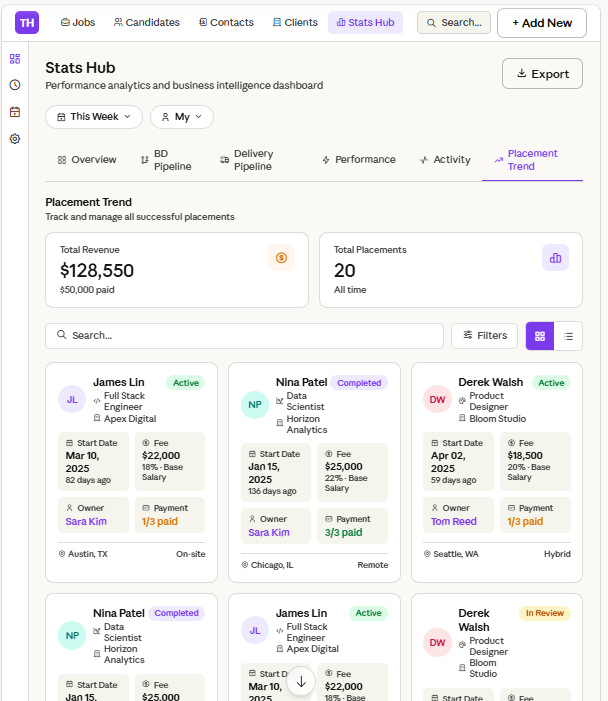
AI-powered talent management & recruitment platform by PowerGate Software
Read more: Top software studios specializing in building AI-powered fintech platforms for early-stage startups
2.4 Thoughtworks
Thoughtworks is a global technology consultancy that combines design, engineering, and AI.
AI agent architecture and development capabilities: AI/works™ supports multi-agent systems in which specialized agents collaborate across software development lifecycle tasks. RAG-based agents retrieve enterprise data to complete tasks, while workflow agents use the ReAct approach to create and test business rules through authorized tools.
Security and governance controls:
- Access control: Authentication and permission management for agents, models, and tools.
- Sandboxing: Runs and tests generated code in isolated environments before execution.
- Human approval: Requires human review for sensitive actions or changes.
- Audit trails: Records agent activities and tool usage for auditing.
- Policy enforcement: Applies access policies and resource limits during agent execution.
Deployment track record and client evidence:
- A mortgage finance client: PoliBot automated policy rule creation and reduced ticket processing time by approximately 40% during the MVP stage.
- Parloa: An organizational harness for agents was built into the production environment, reducing p95 latency by 52-76% across three production endpoints.
- Morgan Stanley: A tiered autonomy model was applied to classify more than 410,000 code hygiene and CVE issues.
Enterprise integration and operational readiness: MCP connects agents with enterprise tools such as Jira, GitHub and databases. Agent/works™ supports agent management across multiple frameworks, models and cloud environments, with integration capabilities for AWS, Google Cloud, Microsoft Azure and Databricks. The platform also supports agent management, testing, deployment and maintenance.
Best fit: Large enterprises that expect to run many agents and want centralized control over permissions and policies.
Web: https://www.thoughtworks.com/
2.5 Accenture
Accenture is a global professional services firm whose AI Refinery platform is built on NVIDIA AI Enterprise.
AI agent architecture and development capabilities: Accenture develops multi-agent systems through its AI Refinery platform and Distiller framework. Its architecture includes three main agent roles:
- Orchestrators: Coordinate tasks and manage interactions between agents.
- Super Agents: Break down complex requests into smaller tasks.
- Utility Agents: Handle specific functions within a workflow.
Businesses can also build custom agents and connect them to their own data and tools.
Security and governance controls:
- Agent Shield: Developed with Anthropic, this solution helps organizations identify, monitor and protect AI agents against security threats.
- Responsible AI checks: AI Refinery’s Orchestrator can apply compliance checks to requests and reject those that do not meet configured requirements.
These capabilities should be assessed separately when defining a project’s security requirements; they are not necessarily included in every deployment.
Deployment track record and client evidence: Repsol provides an example of Accenture’s agentic AI work. According to Accenture’s 2025 annual report, 22 custom AI agents were supporting production cases at the energy company. Repsol also planned to expand the initiative to 90 agents and involve more than 3,000 employees.
Enterprise integration and operational readiness: AI Refinery connects agents with external tools through protocols such as Agent-to-Agent (A2A) and Model Context Protocol (MCP). Accenture also works with ServiceNow through a Forward Deployed Engineering program, where technical teams help customers build agentic workflows and move them from pilot to production.
Best fit: Large enterprises that need agents from several vendors to work together.
Web: https://www.accenture.com/

AI-powered talent management & recruitment platform by PowerGate Software
2.6 HCLTech
HCLTech is a global technology services company. Its work covers IT consulting, engineering, data and AI, and cybersecurity.
AI agent architecture and development capabilities: AI Force supports single-agent and multi-agent systems, letting multiple agents coordinate complex workflows across IT operations, software engineering, data engineering and business process automation. Agentic Studio and RAG Builder cover agent design, knowledge retrieval and task orchestration for enterprise needs.
Security and governance controls:
- Prompt protection: Detects prompt injection, PII exposure, toxic content, bias and malicious links.
- Access control: Supports user management, LDAP and enterprise identity integration.
- Governance: Provides policy enforcement, audit logging and observability to monitor agent activities.
- Data protection: Supports TLS 1.3 encryption for data in transit.
Deployment track record and client evidence:
- IT operations: Deployed two agents for a global electronics distributor to automate incident triage and recommend resolutions. Results included 35% higher engineer productivity and 28% lower average incident handling time.
- HR operations: Configured 19 Oracle HCM AI agents for a global telecommunications company, supporting recruitment, onboarding and employee services. The project reported a 50% reduction in onboarding effort per new hire.
- Clinical evaluation: Deployed AIRA, a multi-agent system for a global MedTech company, to automate literature screening, evidence extraction and validation. It reduced the effort required for recurring Clinical Evaluation Report (CER) updates by 35%.
Enterprise integration and operational readiness: AI agents integrate with enterprise systems such as SAP, Oracle, ServiceNow, Jira and GitHub through prebuilt connectors and custom integrations. They support on-premises, hybrid and public cloud deployment. A logistics project also used AWS AgentCore, CI/CD pipelines and CloudWatch to manage agent orchestration, deployment and monitoring.
Best fit: Enterprises that need agent development and deployment across IT, HR or other business workflows, with security controls and enterprise system integration.
Web: https://www.hcltech.com/
2.7 Keyhole Software
Keyhole Software is a US-based custom software consultancy. Its agentic AI service uses AI agents within the software development process.
AI agent architecture and development capabilities: Develops repository-integrated agents for coding, testing, documentation, and legacy system modernization. Its published work focuses on agent-assisted software development rather than multi-agent business applications.
Security and governance controls:
- Access control: Task-specific permissions and restricted access to production systems.
- Human oversight: Approval of sensitive actions and mandatory code reviews before integration.
- Security measures: Prompt injection protection and audit logs for agent activities.
Deployment track record and client evidence: Keyhole reports using agentic workflows to modernize a legacy platform for an insurance provider in Kansas City. The project covers the UI, services, and database, with an estimated delivery time of five months compared with the original 18-24-month estimate. The project was still in progress when reported.
Enterprise integration and operational readiness: Agentic workflows integrate with GitHub, Azure DevOps and AWS, supporting on-premises and hybrid environments. Deployment practices include CI/CD, Docker, logging, monitoring, backup and rollback.
Best fit: Teams that want senior engineers to modernize software with governed AI tools.
Web: https://keyholesoftware.com/
2.8 Provectus
Provectus develops enterprise AI agents for document processing, workflow automation, healthcare and software modernization. Its solutions combine multi-agent orchestration, enterprise integrations and security controls.
AI agent architecture and development capabilities: The main areas include multi-agent systems, document intelligence agents, and workflow automation agents. These systems use orchestration to coordinate tasks, RAG and memory to retrieve relevant information, and APIs to connect with enterprise tools. Use cases include regulatory document processing, medical record analysis, and business process automation.
Security and governance controls:
- Encryption and role-based access control (RBAC) to protect data and restrict access.
- Audit logging to track agent activities.
- External permission controls to limit access to tools and data.
- Human approval for high-impact actions.
- Output validation against source documents before tasks are completed.
Deployment track record and client evidence:
- Citation: Developed agents to process compliance documents and support ISO and SMAS certification workflows.
- Cancer diagnostics: Used agents to extract more than 50 patient attributes from pathology reports and clinical notes, processing a repository of over 100 million documents.
- Blue Ridge: Used multiple agents to analyze database schemas, plan migrations and generate tests.
- Mad Mobile: Developed a customer service agent integrated with Salesforce. The project was still in development, with production deployment planned.
Enterprise integration and operational readiness: Agents connect to enterprise systems such as CRM, ERP, email and document repositories through APIs and MCP-based integrations. Deployment supports client-approved environments, with monitoring, credential management and recovery mechanisms. The internal Barley system demonstrates integration with Slack, Jira, Confluence, GitHub and CRM while preserving existing access permissions.
Best fit: Enterprises building multi-agent systems for document processing and workflow automation, with enterprise integration and human oversight.
Web: https://provectus.com/

3. Frequently asked questions
3.1. What makes an AI agent architecture secure?
A secure AI agent architecture limits what each agent can access and which actions it can perform. Each agent should have a separate identity and only the permissions needed for its assigned tasks. Sensitive operations, such as modifying records or transferring funds, should require human approval. The system should also log agent activities and undergo regular security testing to detect vulnerabilities.
3.2. What are the biggest security risks of deploying AI agents?
The main security risks include:
- Prompt injection: Malicious instructions hidden in documents or external content can manipulate an agent’s behavior.
- Unauthorized access: Excessive permissions may allow agents to access sensitive data or perform actions beyond their assigned roles.
- Data leakage: Agents may expose confidential information through their responses, connected tools or shared data.
- Unintended actions: Agents may make incorrect decisions or execute actions that were not intended by the user.
- Risks in multi-agent systems: A compromised agent may affect other agents through shared data or connected tools.
3.3. How can businesses monitor and control AI agents after deployment?
Businesses can maintain control over AI agents through several measures:
- Monitor agent activities: Track data access, tool usage, and actions performed during each workflow.
- Maintain audit logs: Record agent activities to identify unusual behavior and trace actions back to individual agents.
- Review access permissions: Regularly check and adjust permissions when an agent’s responsibilities change.
- Require human approval: Keep human oversight for sensitive operations, such as modifying records or transferring funds.
- Conduct security testing: Test the system regularly to identify vulnerabilities and address weaknesses as the system evolves.
The eight companies differ in their AI agent experience, security controls and deployment evidence. Before choosing a provider, check whether its experience comes from production projects, pilots or general AI application development. Make sure its security measures also match the level of access and autonomy your agents will require.