
The software houses for AI agent integration in data-heavy apps build the data pipelines, warehouses, and system connections that let an agent work on real business data. Without that foundation, an agent that draws on several systems can return incomplete or inaccurate answers. Based on company websites and public profiles, this article profiles eight firms: Level60 Consulting, PowerGate Software, Reliancy, Inductivee, GrowExx, Stackcone, Valiotti Data, and Enso Labs, and gives a checklist for evaluating them.
1. What makes a software house specialized in AI agent integration for data-heavy apps
Most agencies can connect a large language model to an app. Data-heavy apps are harder, because the agent has to pull from several systems and work with data that keeps changing. A specialized software house stands out in three areas:
- Data engineering as core work: An agent answers as well as its data allows. A specialized firm designs the pipelines, warehouses, and semantic models behind it, and treats data quality, permissions, and governance as part of the building.
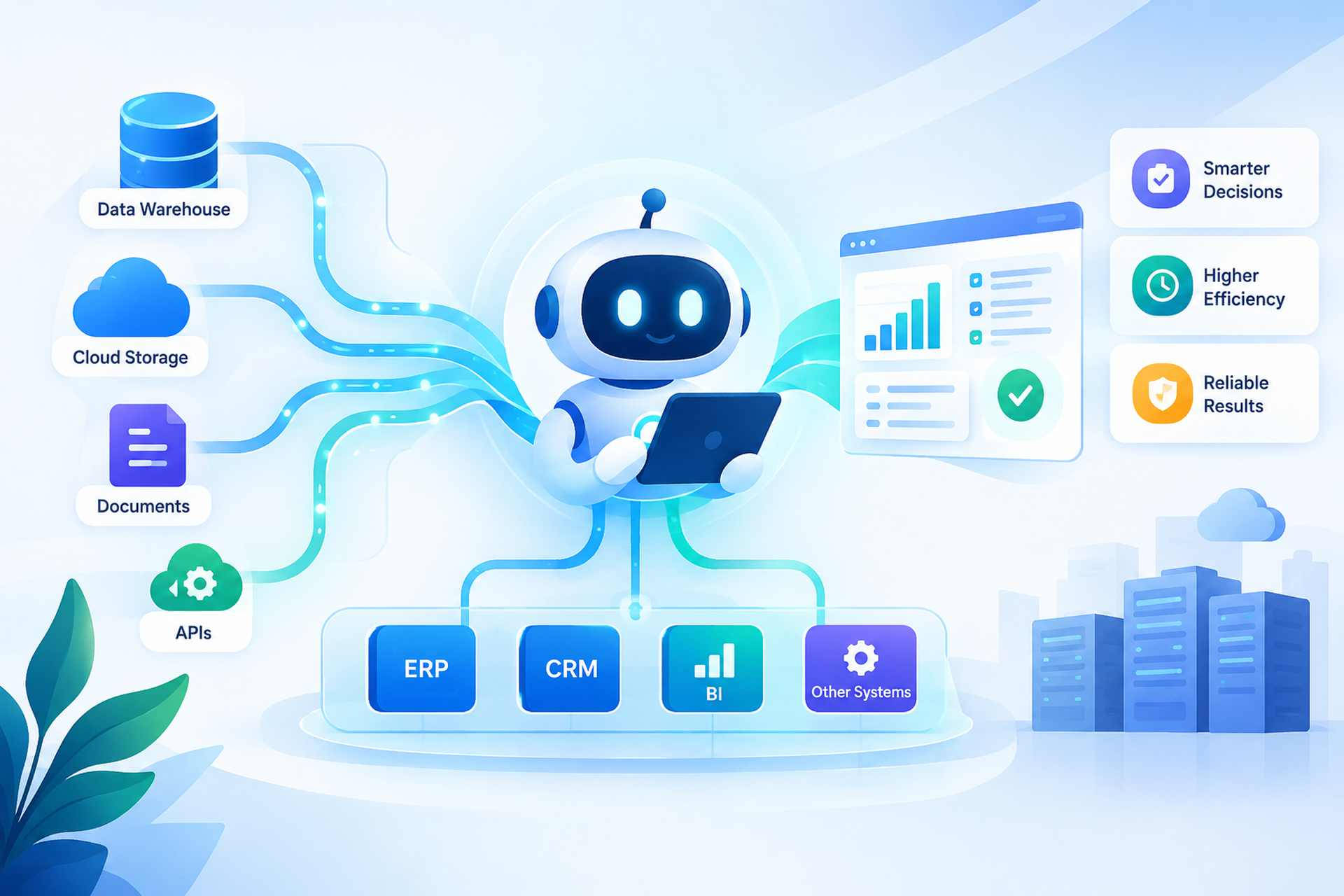
- Controlled connections to business systems: Production agents need governed access to ERP, CRM, databases, document repositories, or internal APIs. A capable firm names the systems involved and explains how it controls each connection.
- Reliability after launch: A demo says little about production performance, so a specialized firm measures correctness, monitors the agent, and keeps humans involved in consequential actions. It also plans for changes in models and source data.
2. Top 8 software houses offering AI agent integration for data-heavy applications
Quick comparison table of the 8 software houses
|
Software house |
Best for |
Data and AI focus |
Certifications |
|---|---|---|---|
|
Level60 Consulting |
Companies with fragmented operational data |
Data lakehouse, Microsoft Fabric, agentic systems and copilots |
No information |
|
PowerGate Software |
Long-term partnerships in compliance-sensitive sectors |
AI agents, RAG, workflow automation, data analytics, BI |
ISO 9001:2015, ISO 27001:2022 |
|
Reliancy |
Microsoft-ecosystem teams with Fabric-based data |
Microsoft Fabric, Agentic AI, governed data foundations |
No information |
|
Inductivee |
Enterprises that need data preparation before agents |
Enterprise data liquidity, RAG pipelines, multi-agent orchestration |
No information |
|
GrowExx |
Regulated enterprises with ERP, CRM, and large datasets |
Data platforms, MLOps, RAG pipelines, AI agents |
ISO 27001, ISO 9001 |
|
Stackcone |
Teams that want fixed scope and full handover |
RAG assistants, MCP agents, data engineering |
No information |
|
Valiotti Data |
Teams whose analytics agents lost trust |
Analytics agents, context engineering, text-to-SQL evals |
No information |
|
Enso Labs |
Document-heavy and financial-data workflows |
Multi-agent systems, RAG, MCP servers, managed operations |
No information |
Note:
- The information and statistics in this article were last updated on 5 Nov 2026 based on data from the official websites of the respective companies and B2B listing platforms such as Clutch and GoodFirms.
- The order in which companies appear on this list does not reflect their ranking or capability and should not be interpreted as an endorsement of one company over another.
2.1. Level60 Consulting
Founded in 2004, Level60 Consulting is a US software and AI consulting firm that builds the data platform first and then the agents that run on it. It has offices in Nashville, Boston, Ithaca, Seattle, and Bogotá.
Best for: Companies with fragmented operational data who want a single partner for both the data layer and agents.
How it meets the criteria:
- Data engineering as core work: It designs lakehouses on Microsoft Fabric and Snowflake with automated ingestion pipelines, dbt-based modeling, and governance, lineage, and access control. It reports cutting data preparation time by more than 60% on one Fabric lakehouse.
- Controlled connections to business systems: It builds multi-agent systems and copilots on top of the systems clients already run, with single sign-on, permissions, and audit trails. It does not name specific ERP or CRM connectors.
- Reliability after launch: Each agent ships with an evaluation harness, is scored on client data before launch and monitored afterward, and the team trains client staff to run the system. It does not mention any certifications.
Web: https://level60consulting.com/
2.2. PowerGate Software
PowerGate Software is a global AI-powered product studio founded in 2011 and based in Hanoi, Vietnam, with offices in the US, UK, Australia, and Canada. For AI agent integration in data-heavy apps, it combines AI agents, workflow automation, RAG, data analytics, BI, and long-term product maintenance.
Best for: Teams in compliance-sensitive sectors such as healthcare and fintech seeking a long-term partner, where stable production operation matters more than a quick demo.
How it meets the criteria:
- Data engineering as core work: Its AI services sit alongside data analytics and BI development, and its RAG offering combines large language models with a client’s internal data to return context-aware answers.
- Controlled connections to business systems: In healthcare, it built a HIPAA-compliant telepharmacy platform for a US pharmacy network that integrates with existing EHR systems and automates prescription refill workflows through REST APIs. This is a systems-integration project rather than an AI agent deployment, but it shows how the team handles regulated data flows.
- Reliability after launch: The company holds ISO 9001:2015 and ISO 27001:2022 certifications, and states that its AI solutions are aligned with the U.S. AI RMF, EU AI Act, GDPR, and HIPAA. Dedicated team and maintenance services provide post-launch support.
Web: https://powergatesoftware.com/

Top software houses for AI agent integration in data-heavy apps
2.3. Reliancy
Reliancy is a data and AI engineering consultancy based in Minneapolis, Minnesota. It specializes in Microsoft Fabric and Agentic AI, and it designs pipelines, data definitions, and agent access as one foundation.
Best for: Teams on the Microsoft ecosystem (Microsoft 365, Azure, Dynamics, Power BI) that need agents working on Fabric-based data.
How it meets the criteria:
- Data engineering as core work: Fabric implementation and migration, pipelines, integration, data quality, and shared semantic models prepared for AI use.
- Controlled connections to business systems: It builds agents with explicit boundaries, approved systems and approved actions, and human oversight. In one example, an agent can explain a margin change but cannot alter a planning record without a separately approved action.
- Reliability after launch: It builds control around evaluation, review, and monitoring, and its principal engineers stay hands-on from architecture through production.
Web: https://www.reliancy.com/
2.4. Inductivee
Inductivee Intelligence is a remote-first AI engineering studio with global delivery that builds multi-agent systems and RAG pipelines for enterprises. Its stated focus is “enterprise data liquidity,” which means preparing enterprise data so that agents can use it.
Best for: Enterprises that need legacy data prepared before building agents, or workflows where several agents share the same data.
How it meets the criteria:
- Data engineering as core work: It uses vector embeddings, semantic ETL, and RAG pipelines to make proprietary data usable by agents.
- Controlled connections to business systems: It builds integration layers that extract and vectorize data from legacy ERP systems such as SAP, Oracle, and Dynamics, and it coordinates agents with LangChain, CrewAI, AutoGen, and LangGraph.
- Reliability after launch: It states that it uses human approval checkpoints for irreversible actions and red-team testing, and offers managed services with SLAs for uptime and reasoning accuracy. It names no clients, and the dashboard figures it shows are labeled illustrative.
Web: https://www.inductivee.com/
2.5. GrowExx
GrowExx is an enterprise AI agent development company with offices in India, the US, and the UAE. It builds agents on top of existing ERP, CRM, and data platforms for BFSI, manufacturing, healthcare, and retail.
Best for: Enterprises in regulated industries whose agents must read from and write to existing business systems and large operational datasets.
How it meets the criteria:
- Data engineering as core work: Data platforms, MLOps, and RAG pipelines form the base layer the agents run on.
- Controlled connections to business systems: It reports production integrations with SAP, Oracle, Salesforce, NetSuite, and ServiceNow through native APIs, MCP servers, and custom connectors, with role-based access control.
- Reliability after launch: Every agent ships with an evaluation harness, cost-per-task dashboards, and drift alerts, and managed services cover monitoring, retraining, and audit readiness. It holds ISO 27001 and ISO 9001 certifications.
Web: https://www.growexx.com/

GrowExx connects AI agents to ERP, CRM, and data platforms for regulated industries
2.6. Stackcone
Stackcone is an AI implementation studio serving UK and US businesses. Its AI work centers on production agents, RAG assistants, and the data pipelines beneath them, and it also builds the web, mobile, and cloud software those systems plug into.
Best for: Teams that need an AI assistant or workflow agent running on their own data, with scope and price agreed before the build, and that want to own the system after launch.
How it meets the criteria:
- Data engineering as core work: ETL pipelines, dbt, Airflow, and Snowflake or BigQuery migrations. One project streams events into BigQuery in near real time with schema checks and error dashboards.
- Controlled connections to business systems: Its workflow agents use MCP and connect to helpdesk, CRM, ERP, and ticketing systems, with approval steps, audit trails, and regional hosting when required. Its projects focus on data pipelines and APIs rather than agent deployments.
- Reliability after launch: Delivery includes testing before launch, monitoring, tracing, and runbooks, and each release runs against a test set of real questions. Delivery is GDPR-aware, and the studio says it does not claim certifications it does not hold.
Web: https://www.stackcone.com/
2.7. Valiotti Data
Valiotti Data is a data and AI analytics consultancy established in 2019, with entities in the US and EU. Analytics agents are one of its services alongside fractional CDO work, and it builds them on top of existing data warehouses. It reports taking on 2 new clients per quarter for this service.
Best for: Teams whose earlier analytics agents lost trust because of hallucinations and that need a measurable reliability figure, starting with one domain over an existing warehouse.
How it meets the criteria:
- Data engineering as core work: It resolves ambiguous metric definitions and conflicting dbt models through context engineering, which goes beyond adding a semantic layer.
- Controlled connections to business systems: It works with Snowflake, BigQuery, Databricks, Redshift, and Postgres, and existing BI tools such as Tableau, Looker, Power BI, and Metabase stay in place without migration. Its agents work on warehouse data, and it describes no agents that write into ERP or CRM systems.
- Reliability after launch: A text-to-SQL eval suite of 20-50 business questions runs in CI on every dbt model or context change. Rollout proceeds one domain at a time, with adoption KPIs reported monthly and a monthly maintenance retainer after implementation.
Web: https://www.valiotti.com/
2.8. Enso Labs
Enso Labs is a principal-led AI consulting studio in New York, founded by Sav Banerjee. It builds and operates AI agents connected to client data and business systems, and under its forward-deployed model, one senior advisor who also builds stays with the client from strategy to production.
Best for: Document-heavy and financial-data workflows in finance, healthcare and pharma, manufacturing, or B2B tech, where one principal stays accountable for strategy and delivery.
How it meets the criteria:
- Data engineering as core work: It builds RAG knowledge systems on client data, such as five brand knowledge bases in a pharma deployment, and a market-intelligence pipeline that processed 731 documents in one run for a Fortune 500 manufacturer.
- Controlled connections to business systems: It develops MCP servers and connects agents to client tools through the Claude API and N8N. One of its LangGraph pipelines has eight stages and four parallel data fetchers.
- Reliability after launch: It provides evals, observability, monitoring, and tuning, with optional managed operations after the build. Its production evidence is company-reported: it runs 23 scheduled agent workflows for its own operations and cites client results such as 83% faster campaign launches in pharma.
Web: https://ensolabs.ai/

3. Checklist for evaluating a software house before you commit
Public profiles are a useful starting point, but they do not prove that a firm can deliver reliable AI agents in a data-heavy environment. After checking each shortlisted firm against the three criteria in section 1, check three areas that public profiles rarely cover in enough detail:
- Practical evidence: Look for projects involving similar data volumes, system integrations, and workflow complexity. Ask what the team delivered, what challenges it faced, and what results can be measured.
- Security and governance: Verify the scope and validity of certifications such as ISO 27001 directly with the issuer. Ask how the firm manages data hosting, access permissions, and human approval for sensitive agent actions.
- Ownership and maintenance: Before signing, clarify who owns the source code, configurations, and evaluation datasets when the engagement ends. Establish who is responsible for updates, maintenance, and incident resolution after launch.

Source: escalent.coSource: escalent.co
4. Frequently asked questions
1. Are there really software houses that specialize in AI agent integration for data-heavy applications?
Yes, although most firms cover only part of the problem. Reliancy designs pipelines, data definitions, and agent access together, and GrowExx builds agents on top of existing ERP, CRM, and data platforms. Others lead with one layer: Level60 Consulting starts with the data platform, and Valiotti Data focuses on analytics agents over existing warehouses. The comparison table in section 2 shows how the eight firms differ.
2. Why do so many AI agents fail on data-heavy applications?
Most failures trace back to the data rather than the model. Common causes include:
- Fragmented or poorly structured data: Data is often fragmented, poorly structured, or hard to access in real time.
- Conflicting metric definitions: Different definitions across systems produce inconsistent answers. Valiotti Data targets this problem through context engineering.
- Weak retrieval, unclear permissions, and insufficient validation: These issues lead to incomplete or inaccurate results.
3. How is AI agent integration different from a chatbot built on company data?
The difference lies in what each system does with company data:
- AI agents: Read from and write to business systems, run multi-step workflows, and keep an audit trail.
- Chatbots on company data: Retrieve documents and answer questions.
The right partner among the software houses for AI agent integration in data-heavy apps depends on where your data problem starts. Scattered data points to Level60 Consulting or Inductivee, and a Microsoft Fabric stack points to Reliancy. Agents working inside ERP and CRM under audit suit GrowExx. One partner for agents, analytics, BI, and long-term maintenance in a compliance-sensitive sector suits PowerGate Software. Stackcone, Valiotti Data, and Enso Labs cover fixed-scope builds, measurable analytics accuracy, and document-heavy work. Confirm the match with a small proof of concept on your own data.