As AI agents become more capable, developers now have more framework options than ever before. Two names that often appear in technical discussions are Agno and AutoGen. While both frameworks help developers build AI-powered applications, they are designed with different priorities in mind. This article compares Agno vs AutoGen to help you understand their architecture, key capabilities, strengths, and the types of projects each framework is best suited for.
1. An overview of Agno and AutoGen
Before comparing Agno and AutoGen, it is worth understanding the purpose behind each framework. Although both simplify AI agent development, they were created to solve different challenges. Knowing their design philosophy makes it much easier to understand why they differ in architecture, workflow, and real-world applications.
1.1. What is Agno?
Agno is an open-source framework for building AI agents and agentic applications. It aims to reduce the amount of infrastructure developers need to write by providing many essential components out of the box. Instead of assembling multiple libraries for memory, retrieval, tool integration, and workflow management, developers can use Agno to build production-ready AI applications within a unified framework.
One of Agno’s main strengths is its focus on practical software development. Rather than treating AI agents as isolated experiments, Agno encourages developers to build systems that can be deployed, monitored, and maintained in production environments.
1.2. What is AutoGen?
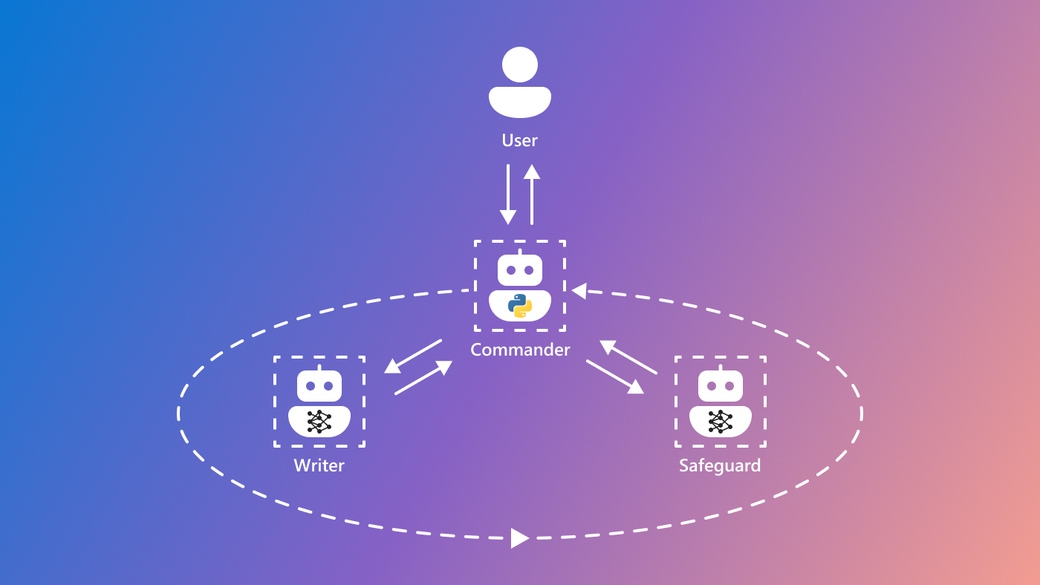
AutoGen is an open-source framework developed by Microsoft for creating AI applications based on multiple collaborating agents. Instead of focusing primarily on individual AI assistants, AutoGen emphasizes communication between specialized agents that work together to complete complex tasks.
The central idea behind AutoGen is that a single AI model may not always produce the best results for complicated problems. Instead, different agents can take on different responsibilities, much like members of a project team.
Source: microsoft.com
2. A comparison between Agno and AutoGen
At a high level, Agno and AutoGen share many similarities. Both frameworks support modern AI development by allowing agents to reason, use external tools, access knowledge, and interact with different LLM providers.
However, their similarities begin to fade once you look beyond these core capabilities. Agno is primarily designed to simplify the development of production-ready AI applications, while AutoGen focuses on enabling sophisticated collaboration between multiple AI agents. This difference influences everything from their architecture and learning curve to their ideal use cases.
The table below summarizes the most important differences between the two frameworks.
| Criteria | Agno | AutoGen |
|---|---|---|
| Primary focus | Production-ready AI applications | Multi-agent collaboration and orchestration |
| Design philosophy | Opinionated with built-in components | Flexible and highly customizable |
| Learning curve | Relatively easy for beginners | Moderate to advanced |
| Agent architecture | Single-agent and multi-agent applications | Multi-agent systems are the primary focus |
| Workflow management | Built-in workflows and orchestration | Developers design their own interaction patterns |
| Memory support | Built-in memory management | Available but requires more configuration |
| Knowledge integration | Native support for retrieval and knowledge bases | Can integrate with RAG but often requires additional implementation |
| Tool integration | Built-in support for external tools and APIs | Flexible tool integration through custom agents |
| Production readiness | Strong focus on deployment and enterprise applications | Suitable for production but generally requires more engineering effort |
| Customization | Easier to configure with sensible defaults | Greater flexibility for complex agent interactions |
| Best suited for | AI assistants, copilots, enterprise AI applications | Research systems, autonomous workflows, collaborative AI |
2.1. 7 Similarities between Agno and AutoGen
Although they follow different design philosophies, Agno and AutoGen still share a solid foundation. Both frameworks aim to simplify AI agent development and reduce the complexity of working directly with LLM APIs. Some of their common capabilities include:
- Support for multiple LLM providers
- Tool calling for interacting with external systems
- Memory mechanisms to preserve context
- Retrieval-Augmented Generation (RAG) integration
- Multi-step reasoning
- Support for multi-agent architectures
- Open-source development with active communities
As a result, developers can build many of the same application types using either framework. The main difference lies in how those applications are designed and managed rather than what they can ultimately achieve.
2.2. 3 Key differences between Agno and AutoGen
The biggest distinction between Agno and AutoGen lies in their development philosophies.
- Agno prioritizes developer productivity. It provides many production-oriented features by default, allowing teams to build AI applications with less configuration and fewer supporting libraries. This approach reduces boilerplate code and helps developers focus on solving business problems instead of assembling infrastructure.
- AutoGen, on the other hand, prioritizes flexibility. Rather than prescribing a fixed development pattern, it gives developers greater control over how agents communicate, collaborate, and make decisions. This makes AutoGen especially suitable for projects where agent interactions are a core part of the solution.
Another important difference is workflow complexity.
- Agno generally offers a smoother experience for teams building business applications such as AI assistants, document search systems, or enterprise copilots.
- AutoGen often requires more planning because developers must design the behavior of multiple collaborating agents, thereby increasing implementation complexity.
Finally, the two frameworks target slightly different audiences.
- Agno is often a better fit for teams that want to deliver AI-powered products quickly and reliably.
- AutoGen is better suited for developers exploring advanced multi-agent systems, autonomous workflows, or research-oriented applications where flexibility is more important than development speed.
You may need:
- AutoGen vs LangGraph: Which AI agent framework should you choose for your 2026 projects
- Agno vs LangGraph: Choosing the right framework for building AI agents
3. Agno vs AutoGen: Which framework should you choose?
There is no universal winner in the Agno vs AutoGen comparison. Both frameworks are capable of building modern AI applications, but they are optimized for different goals. Your choice should depend on the complexity of your project, your team’s technical expertise, and the level of control you need over agent behavior. In many cases, selecting the right framework early can reduce development effort and make future maintenance much easier.
3.1. Choose Agno if
Agno is an excellent choice for teams that want to build production-ready AI applications without spending excessive time on infrastructure. You should consider Agno if your project involves:
- AI customer support assistants
- Enterprise knowledge assistants
- Internal productivity copilots
- Document search and question-answering systems
- Healthcare AI assistants
- Financial advisory tools
- Business workflow automation
Agno is particularly attractive for startups and product teams because many essential capabilities are already included. Features such as memory, knowledge integration, tool calling, and workflow orchestration work together within a consistent development model, allowing developers to move from prototype to deployment more efficiently.
It is also a strong option for organizations that are adopting AI for business operations rather than conducting AI research. The framework reduces engineering overhead while still providing enough flexibility to build sophisticated applications.
3.2. Choose AutoGen if
AutoGen is a better fit when collaboration between multiple AI agents is central to the application. It is well suited for projects such as:
- Multi-agent research assistants
- Autonomous coding systems
- AI software engineering workflows
- Complex planning and reasoning tasks
- Experimental AI systems
- Agent-based simulations
One of AutoGen’s greatest strengths is the ability to assign different responsibilities to different agents. For example, a planning agent can break down a task, a researcher can gather information, a coding agent can implement the solution, and a reviewer can evaluate the final output before it reaches the user.
This level of flexibility makes AutoGen appealing for advanced AI applications. However, it also means developers are responsible for designing communication patterns, managing agent coordination, and handling additional implementation complexity.
Teams with prior experience in AI agent orchestration are more likely to benefit from AutoGen’s flexible architecture.

Source: diffblue.com
3.3. Recommendation by use case
If you’re still unsure which framework to choose, the following examples can serve as a practical starting point.
| Use case | Recommended framework | Why |
|---|---|---|
| AI customer support chatbot | Agno | Faster development with built-in memory, tools, and knowledge integration |
| Enterprise knowledge assistant | Agno | Well-suited for Retrieval-Augmented Generation (RAG) and document search |
| Internal AI copilot | Agno | Production-focused architecture with less engineering overhead |
| Healthcare AI assistant | Agno | Easier to build secure, production-ready AI applications |
| Financial assistant | Agno | Supports enterprise workflows and external tool integration |
| AI research assistant | AutoGen | Multiple agents can collaborate on complex research tasks |
| Autonomous coding assistant | AutoGen | Different agents can plan, write, review, and improve code |
| Multi-agent workflow automation | AutoGen | Designed specifically for agent collaboration and orchestration |
| Experimental AI systems | AutoGen | Greater flexibility for custom agent interactions |
As a general rule, if your goal is to build an AI-powered product that users will interact with daily, Agno is usually the more practical starting point. If your project depends on sophisticated collaboration between multiple autonomous agents, AutoGen offers greater flexibility despite its steeper learning curve.
Choosing between Agno and AutoGen ultimately comes down to your project’s requirements rather than finding a universally better framework. Agno stands out for building production-ready AI applications with less engineering effort, while AutoGen excels at creating advanced multi-agent systems with highly customizable workflows. By understanding the strengths and trade-offs of each framework, you can select the one that best aligns with your technical goals and long-term product strategy.
|
Build production-ready AI solutions with PowerGate Software: Choosing the right AI framework is only one part of building a successful AI product. Turning an idea into a reliable, scalable solution also requires strong software engineering, product thinking, and experience deploying AI in real business environments. As an AI-Powered software product studio, PowerGate Software helps businesses design, develop, and scale intelligent applications that deliver measurable value. From AI assistants and enterprise copilots to agentic workflows and industry-specific AI solutions, our team combines modern AI technologies with proven product development practices to accelerate your journey from concept to production. Whether you’re evaluating Agno, AutoGen, or another AI agent framework, PowerGate can help you choose the right technology stack and build an AI solution that is secure, scalable, and ready for real-world use. |