
Companies modernizing legacy systems using AI-driven automation help businesses update outdated software, understand legacy code, and reduce manual work. By automating code analysis and documentation, they can make modernization more efficient. If you are looking for a partner to modernize your legacy systems, explore these eight companies: Accenture, IBM Consulting, PowerGate Software, Capgemini, HCLTech, Cognizant, Infosys, and Keyhole Software in this article.
1. Evaluation criteria for AI-driven legacy system modernization companies
Four factors matter most when comparing firms in this field, including:
- Capability: The platforms, services, and customer examples a firm has published for legacy modernization and AI automation.
- Scale: The size of the delivery team and its experience with enterprise clients.
- Certifications: Security and quality standards, such as ISO 27001 and ISO 9001.
- Support after go-live: Maintenance and operations once the new system is running.
2. Top 8 AI-driven legacy system modernization companies worth considering
Use the comparison table and the profiles below to match each firm to the system you need to modernize.
Comparison table
|
Company |
AI-led modernization focus |
Best for |
|---|---|---|
|
Accenture |
GenWizard reverse engineering, AWS Transform, Pega Blueprint |
Large, multi-year programs |
|
IBM Consulting |
watsonx Code Assistant for Z, COBOL to Java |
IBM Z mainframe estates |
|
PowerGate Software |
AI-assisted development, maintenance services, ISO 9001 and 27001 |
Mid-sized firms with specific applications |
|
Capgemini |
Gen AI and agentic AI mainframe refactoring |
COBOL-heavy estates |
|
HCLTech |
AI Force.Software.Mod platform |
Platform-led modernization |
|
Cognizant |
Skygrade, Neuro, Ignition platforms |
Mainframe to cloud moves |
|
Infosys |
Topaz and Live Enterprise Application Development Platform |
Mainframe and packaged-software replacement |
|
Keyhole Software |
Senior-led, AI-accelerated delivery |
Established organizations needing senior engineers |
Note: The information and statistics in this article were last verified on 30 October 2026 based on data from the official websites of the respective companies and B2B listing platforms such as Clutch and GoodFirms. The order in which companies appear on this list does not reflect their ranking or capability and should not be interpreted as an endorsement of one company over another.
2.1 Accenture
Accenture is a global consulting and technology services firm. It approaches legacy modernization by analyzing existing applications with AI. Its GenWizard platform uses generative AI to analyze and document legacy applications. It covers more than 70 technologies, including Java, .NET, mainframe, SAP, and Oracle. Accenture also works with AWS Transform and Pega Blueprint to rebuild applications as cloud-native or low-code systems.
Capability: Accenture says Allianz used GenWizard and Pega Blueprint to shorten its delivery cycles. AWS reports timeline reductions of 30-40% with the Accenture and AWS Transform approach.
Scale: Accenture had approximately 814,000 people. It serves clients in more than 120 countries.
Certifications: Its information security program holds BSI ISO/IEC 27001:2022 and ISO/IEC 27701:2019 certifications.
Support after go-live: Its Shared Service Delivery handles live-service work after launch, including incident and problem resolution and change and release management.
Best for: Large enterprises that run multi-year modernization programs across a mix of technologies are the best match.
Website: https://www.accenture.com/en

2.2 IBM Consulting
IBM Consulting is the services arm of IBM. Its modernization work centers on moving COBOL business services to Java on IBM Z mainframes. IBM’s watsonx Code Assistant for Z performs the translation with IBM’s Granite code model. IBM applies it selectively and step by step instead of rewriting everything at once.
Capability: IBM says the tool preserves the performance, security, and resilience of IBM Z. IBM consultants also help clients decide which applications to modernize first.
Scale: IBM cited 160,000 consultants and clients in more than 175 countries.
Certifications: IBM Corporation holds an ISO/IEC 27001:2022 certificate issued by Bureau Veritas. The certificate’s scope covers IBM consulting and support.
Support after go-live: IBM Application Management as a Service covers application, database, middleware, and platform support. It includes specialist legacy application expertise.
Best for: IBM fits organizations that run core systems on IBM Z mainframes and want to keep the mainframe in place.
Website: https://www.ibm.com/consulting
2.3 PowerGate Software
PowerGate Software is an AI-powered software product studio founded in 2011. It has offices in Vietnam, the US, the UK, Australia, and Canada. For legacy work, it combines AI-assisted development with maintenance and support for existing applications.
Capability: Its published work centers on AI-assisted product development.
Scale: PowerGate Software operates as a mid-sized team across those five offices.
Certifications: It holds ISO 9001 and ISO 27001:2022.
Support after go-live: It offers software maintenance and support, including bug fixes, performance tuning, and scheduled backups.
Best for: The studio suits mid-sized companies that want a dedicated team to modernize or maintain a specific application under certified processes.
Website: https://powergatesoftware.com/
>>> You may need: What is software modernization? Benefits, strategies, and challenges explained
2.4 Capgemini
Capgemini is a global consulting and technology services group that applies generative AI to legacy mainframe code. In May 2025, it launched an automated mainframe refactoring offering. The offering uses generative AI assistants and AI agents to analyze legacy code and extract business rules. It then moves those rules into a modern architecture.
Capability: Forrester named Capgemini a leader in its Application Modernization and Multicloud Managed Services Wave for Q1 2025.
Scale: Capgemini describes itself as a group of more than 410,000 team members in over 50 countries as of September 2026.
Certifications: Capgemini SE holds an ISO/IEC 27001:2022 certificate issued by BSI for its information security management system.
Support after go-live: ISG’s 2023 mainframe report describes Capgemini’s scope as including application services and mainframe operations.
Best for: Companies with large COBOL estates that want automated refactoring instead of a manual rewrite are the main audience.
Website: https://www.capgemini.com
2.5 HCLTech
HCLTech is a global technology firm that applies AI to legacy modernization through its AI Force.Software.Mod platform. The platform also covers API redesign for microservices. This lets teams split a large application into smaller services that are easier to update. HCLTech says the platform can modernize legacy applications up to 60% faster than traditional approaches.
Capability: Everest Group positioned HCLTech as a leader in its 2025 PEAK Matrix for application transformation with AI enablement. IDC MarketScape also named it a leader in its 2023 application modernization assessment.
Scale: HCLTech reports 223,000 employees across 60 countries as of June 30, 2026.
Certifications: HCLTech states that its information security management system holds ISO 27001:2013 and ISO 27701 certifications.
Support after go-live: HCLTech lists application support and maintenance among its services. A dedicated team focuses on operational continuity and minimal downtime.
Best for: HCLTech fits enterprises that want platform-led modernization and a chance to validate ROI before they commit a budget.
Website: https://www.hcltech.com

2.6 Cognizant
Cognizant is a global IT services firm with three platforms for legacy work. Skygrade handles cloud-native modernization, Neuro handles AI engineering, and Ignition handles data and analytics modernization. Its legacy work centers on AI-driven analysis of existing systems.
Capability: Cognizant reports moving a logistics mainframe to OpenShift and cutting its MIPS (mainframe processing load) by 30%. It also cites a claims mainframe migrated to Azure that now automates more than 2 billion claims.
Scale: Cognizant reported a total headcount of 356,700 as of June 30, 2026.
Certifications: Its 2025 sustainability databook lists ISO/IEC 27001:2022 certification valid through July 2027. The same databook lists ISO 22301:2019 business continuity certification valid through June 2027.
Support after go-live: Its application modernization services include application maintenance and management. They also cover ongoing enhancements.
Best for: Organizations that move mainframe workloads to cloud platforms, particularly in logistics and claims, are its closest match.
Website: https://www.cognizant.com
2.7 Infosys
Infosys is a global IT services firm that uses generative AI in its Live Enterprise Application Development Platform, part of Infosys Topaz. The platform extracts business rules from mainframe code and re-engineers the code for the cloud. Clients can also keep the core on the mainframe and expose it through APIs, or replace it with packaged software.
Capability: Forrester named Infosys a leader in application modernization and migration services in Q1 2024. ISG also named it a leader in three mainframe quadrants in 2024.
Scale: Infosys reported a total workforce of 328,062 as of June 30, 2026.
Certifications: Infosys lists ISO 27001:2022, ISO 9001:2015, and ISO 27701:2019 among its certifications.
Support after go-live: Infosys Managed Services offers 24×7 application support. The company says it supports and maintains more than 2,000 client applications.
Best for: Infosys fits companies that are still deciding whether to renew or replace a mainframe application.
Website: https://www.infosys.com
Are there any recommended firms for modernizing legacy systems using AI-driven automation
Read more: Top software agencies experienced in AI-driven SaaS product engineering
2.8 Keyhole Software
Keyhole Software is a US-based consultancy with more than 18 years of delivery experience. It pairs senior architects with AI-accelerated delivery on legacy projects. Its consultants average more than 17 years of experience.
Capability: Keyhole reports moving Kansas City Southern’s COBOL systems to microservices on Azure. It also reports replacing an insurance platform in 5 months, against a typical 18-24 months.
Scale: Keyhole says it works with more than 250 organizations.
Certifications: Keyhole lists a GSA Schedule for federal procurement and Red Hat Ready Partner status among its certifications and partnerships.
Support after go-live: Keyhole trains the client’s team on what it built and stays available after the engagement ends. Its engagements close at a defined handoff point, with ongoing support or staff augmentation as an option.
Best for: Established organizations, including Fortune 100 clients, that need senior engineers for a focused modernization project. Its model favors experienced consultants over a large delivery team.
Website: https://keyholesoftware.com/
3. How to choose among AI-driven legacy system modernization companies
The right firm depends on the system and the risk you can accept. Large integrators such as Accenture and IBM Consulting publish work on mainframes and mixed technology estates. Specialist teams such as PowerGate Software and Keyhole Software position themselves for specific applications and focused projects.
Whichever route you take, begin with a short assessment that produces documented business rules and a test plan. Once the core system exposes clean APIs, you can add LLM-based customer service solutions on top of it without rebuilding the foundation.
Put these questions to each shortlisted firm and ask for written evidence:
- Which steps does AI perform, and which do engineers review by hand?
- How will you prove the new system matches the old one?
- Who owns the extracted documentation and business rules after the project?
- Where is our source code processed, and who can access it?
- Which similar legacy stack have you modernized, and may we speak with that client?
- What support do you provide after go-live, and under which service levels?
4. Frequently asked questions
4.1 How does AI-accelerated modernization work for aging enterprise software?
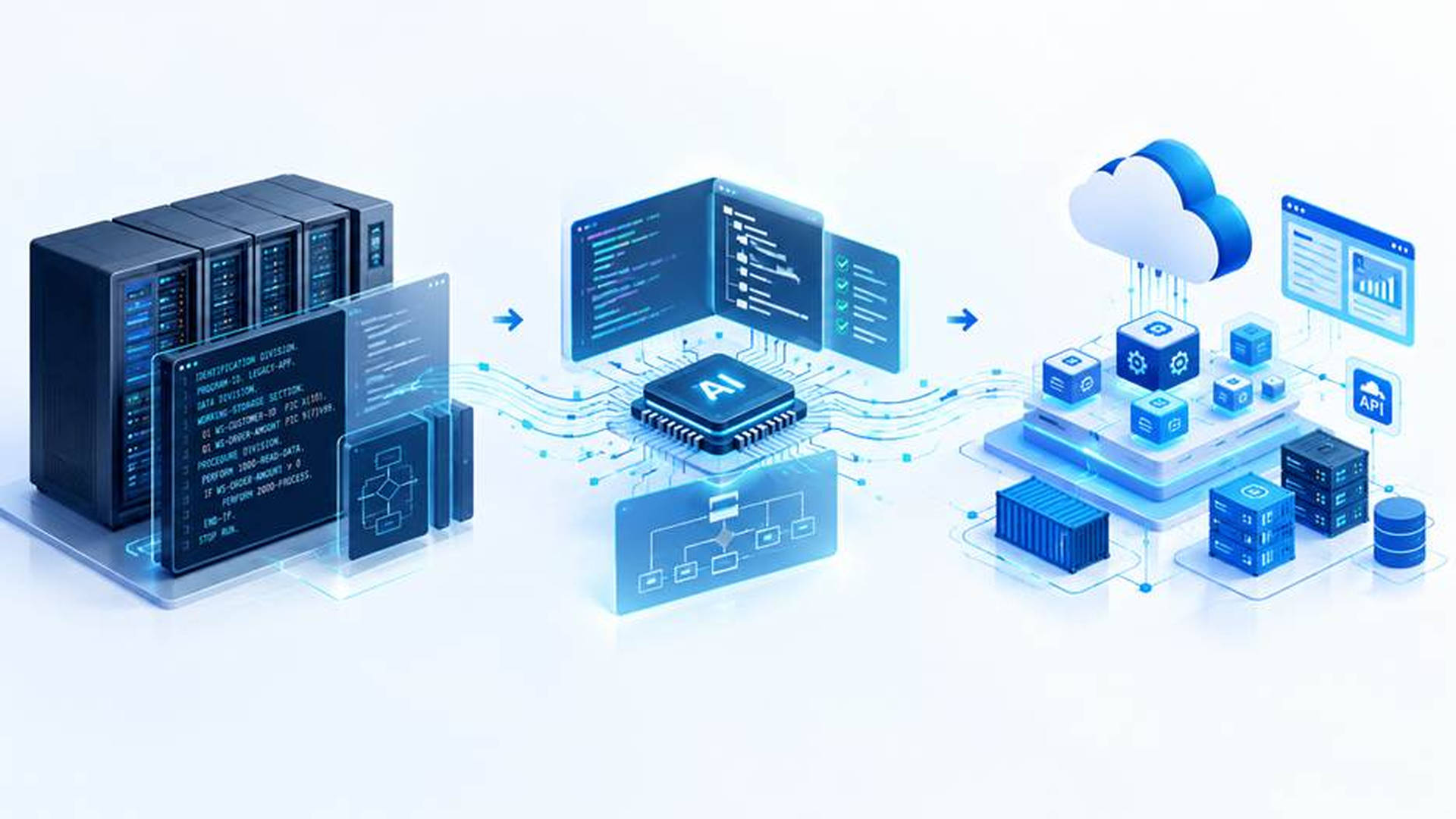
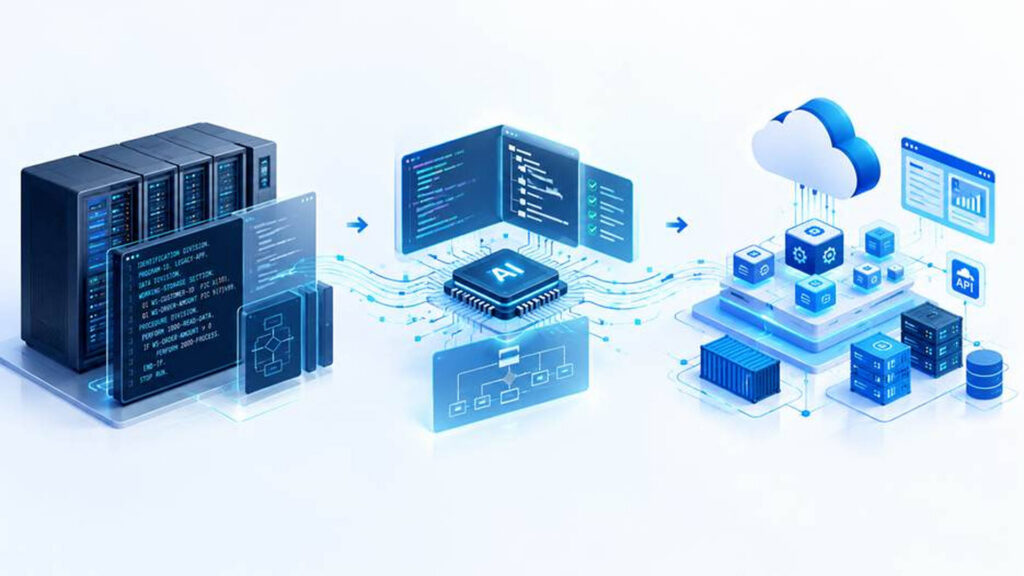
AI-accelerated modernization first uses AI to understand the old system. It then converts the system and checks the result. The work runs in three steps:
- Analyze: AI tools read legacy code such as COBOL and extract its business rules and dependencies.
- Convert: Engineers use those rules to decide what to keep, refactor, or replace. Automation then converts the selected parts, often one application at a time.
- Verify: AI helps generate tests so the team can confirm that the new system behaves like the old one.
4.2 What are the options for modernizing a legacy system?
A company has three options for a legacy system:
- Keep the core system and expose it through APIs: Infosys describes this option for mainframe applications. It fits when the business logic is stable and still works well. The goal is to connect the system to new applications without touching the core.
- Convert it step by step to a modern language or cloud architecture: IBM describes this approach with COBOL to Java. It fits when the system holds business logic worth preserving but its technology holds the business back.
- Replace it with packaged software: Infosys also describes this option for mainframe applications. It fits when the system mostly performs standard functions that a packaged product already covers.
4.3 What are the primary security risks when modernizing legacy systems with AI?
The main security risks when modernizing legacy systems with AI are:
- Exposure of sensitive data during migration.
- Weak access control in the new environment.
- Misconfigured cloud settings.
- Known vulnerabilities carried over from old code into the new system.
- Source code or customer data processed by external AI services without approval.
Two steps reduce these risks. Review each vendor’s security certification, such as ISO 27001. Then run security testing at each stage.
4.4 Why should a company consider AI-assisted refactoring over manual code rewriting?
AI-assisted refactoring is worth considering for two reasons:
- Faster analysis: AI tools can read and document old code faster than a team can by hand. This shortens the analysis stage.
- Less disruption: A team can convert a system into selected parts. Working features stay in place during the change.
Manual rewriting makes more sense for very small systems or designs that cannot be reused.
When choosing among AI-driven legacy system modernization companies, look for evidence. Ask what the firm found in your old system. Then ask how it converted that system and how it proved the new one works the same way. The modernized system will keep supporting daily operations, so confirm what support follows go-live. Then use the profiles above to shortlist two or three firms and request references before you decide.