Outsourcing and Outstaffing are often mentioned together in discussions about software development. Yet, in practice, they serve very different business needs. One focuses on delegation. The other emphasizes collaboration.
So, how do they really differ? And more importantly, which model is right for your company in 2026? In this article, we break down outsourcing vs. outstaffing in a practical, business-oriented way to help you make a confident, informed decision.
1. What is software outsourcing?
Software outsourcing means hiring a third-party vendor to handle an entire project or a specific part of it. From planning to delivery, the vendor takes full responsibility.
In most cases, outsourcing follows a structured workflow: Requirement → Proposal → Development → Delivery → Maintenance
Once requirements are agreed upon, the vendor manages execution while the client mainly monitors progress and reviews outcomes.
| Pros | Cons |
| Predictable costs: Outsourcing usually works on fixed-price or project-based contracts. This makes budgeting easier and reduces financial uncertainty.
Minimal internal management: You do not need to manage developers, conduct technical reviews, or handle HR matters. The vendor takes care of these tasks. Suitable for short-term projects: Outsourcing works well for MVPs, prototypes, and small applications with clear scopes and deadlines. |
Limited direct control: Since the vendor manages the team, your influence over daily operations is relatively low.
Communication risks: Time zones, language barriers, and cultural differences may slow down feedback loops. Vendor dependency: Your success depends heavily on the vendor’s competence, stability, and commitment. |

Outsourcing is a “done-for-you” model: You define the goal and the vendor delivers the result – Source: aapnainfotech.com
2. What is outstaffing?
Outstaffing, also known as dedicated team or staff augmentation, involves hiring remote developers through a vendor. These developers legally belong to the vendor but work as part of your internal team. They follow your workflows, attend your meetings, and report to your managers.
In an outstaffing model, responsibilities are clearly divided between the client and the vendor, especially in terms of quality management.
The client is responsible for technical quality:
- System architecture and technical direction
- Code standards and best practices
- Sprint planning and delivery quality
- Code reviews and technical decisions
- Product roadmap execution
- In other words, the client owns the technical outcomes of the project.
The vendor is responsible for the quality:
- Recruiting qualified developers
- Verifying technical skills and experience
- Ensuring cultural and communication fit
- Providing continuous training
- Managing retention and team stability
This means the vendor guarantees the quality of talent, while the client ensures the quality of execution.
This clear separation allows companies to scale their development capacity without losing control over technical standards.
| Pros | Cons |
| High Level of Control: You manage the team directly. This improves transparency, alignment, and decision-making.
Flexible team scaling: You can easily add or reduce developers based on project needs. Ideal for long-term products: Outstaffing supports continuous development, maintenance, and product evolution. |
Requires strong management skills: Without clear leadership, the team may lose focus and productivity.
Depending on internal processes: Weak planning, unclear documentation, or inconsistent feedback can limit performance. |
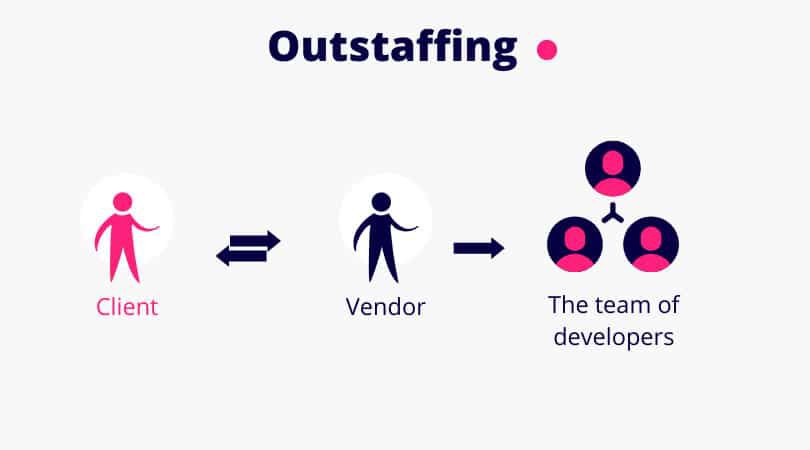
Outstaffing is essentially an “extended in-house team” model: You lead, and the vendor supports – Source: alcor.com
3. Key differences between Outsourcing and Outstaffing
Below is a practical comparison of the two models:
| Criteria | Outsourcing | Outstaffing |
| Control | Low | High |
| Cost structure | Fixed / Project-based | Monthly / Per-developer |
| Management | Vendor | Client |
| Flexibility | Medium | High |
| Best for | Short-term projects | Long-term products |
| IP risk | Higher | Lower |
| Knowledge transfer | Limited | Strong |
4. When should you choose Outsourcing or Outstaffing?
Choosing the right model depends on your business context, not just your budget.
1 – Outsourcing is suitable when
- You are building an MVP or prototype
- You need a small or medium-sized application
- You lack an internal tech team
- You want fast, end-to-end delivery
Example scenario: A startup wants to validate a mobile app idea within four months. They have limited funding and no technical co-founder. Outsourcing allows them to launch quickly without building an internal team.
In this case, speed and simplicity matter more than long-term control.
2 – Outstaffing is suitable when
- You are developing a long-term product
- You already have a CTO or strong PM
- You want to build core technical expertise
- You expect frequent changes and iterations
Example scenario: A SaaS company is expanding its platform globally. It has an experienced product team but needs more developers. Outstaffing helps them scale while keeping full control over architecture and roadmap.
Here, ownership and continuity are the top priorities.
You may need: Common mistakes when choosing between Outsourcing and Outstaffing
Many companies struggle not because of the model itself, but because of poor decision-making. Here are the most common mistakes.
- Choosing based on price alone: The cheapest option often leads to hidden costs, rework, and delays. Value matters more than hourly rates.
- Not evaluating vendor capability: Ignoring technical expertise, portfolio quality, and team stability can result in poor delivery.
- Lack of SLA and KPI definition: Without clear service-level agreements and performance metrics, it becomes difficult to manage expectations.
- Weak management preparation: Especially for outstaffing, companies often underestimate the importance of internal processes, documentation, and leadership.
Final thoughts: There is no universal “best” model. There is only the model that fits your current business stage, resources, and goals. Before deciding, ask yourself four key questions:
- Budget: Do you prefer fixed project costs or long-term monthly investment?
- Team: Do you have technical leadership to manage developers?
- Timeline: Is speed more important than long-term scalability?
- Vision: Are you building a one-time product or a long-term platform?
Your answers will naturally guide you toward outsourcing or outstaffing. Sometimes, a hybrid approach also works, starting with outsourcing and gradually moving to outstaffing as the product matures.
|
Choosing between outsourcing and outstaffing is rarely a binary decision. In reality, most growing companies need a flexible, evolving engagement model. This is where PowerGate Software positions itself not just as a service provider, but as a long-term strategic partner. Instead of pushing a single model, PowerGate Software works closely with clients to assess:
Based on this analysis, PowerGate Software recommends the most suitable engagement structure. Talk to PowerGate Software today and design a development strategy that grows with your business. |