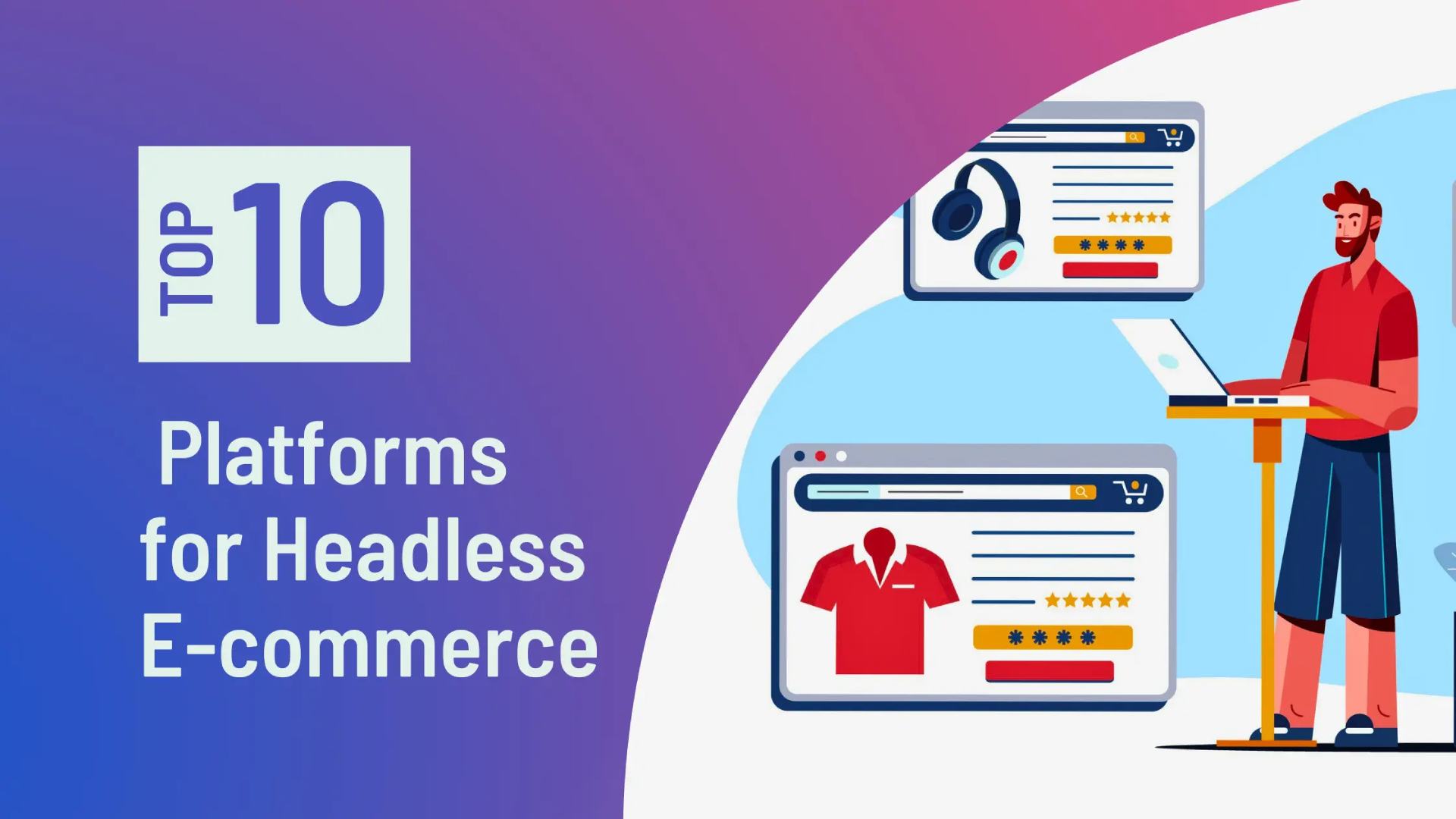

Headless commerce is becoming a popular choice for businesses that need more flexibility, better integrations, and custom digital experiences. Today, many companies are comparing different headless ecommerce platforms to find the right balance between scalability, customization, and operational complexity. In this article, we review 10 popular headless ecommerce platforms, including MedusaJS, Shopify Plus, commercetools, and Saleor, to help businesses understand which solution fits their technical and business needs best.
Quick comparison table
| Platform | Type | Best For | Complexity |
| MedusaJS | Open-source headless commerce | Custom commerce systems | High |
| Shopify Plus | SaaS with headless support | Fast-growing ecommerce brands | Medium |
| commercetools | Enterprise composable commerce | Large enterprises | High |
| Saleor | Open-source headless commerce | Modern custom storefronts | Medium-High |
| BigCommerce | SaaS with headless capabilities | SMEs needing flexibility | Medium |
| Adobe Commerce | Enterprise ecommerce platform | Complex enterprise commerce | High |
| Commerce Layer | API-first commerce platform | Multi-market commerce | Medium-High |
| Elastic Path | Composable commerce platform | Enterprise integrations | High |
| WooCommerce | WordPress ecommerce plugin | Content-driven ecommerce | Low-Medium |
| Salesforce Commerce Cloud | Enterprise SaaS commerce | Large omnichannel retailers | High |
1. MedusaJS
MedusaJS is an open-source headless ecommerce platform built with Node.js. It focuses on API-first commerce architecture and allows businesses to build fully customized ecommerce systems. Unlike traditional ecommerce platforms, MedusaJS mainly provides the backend commerce engine. Developers can then connect it with modern frontend frameworks such as Next.js or React.
PowerGate Software’s insights:
- Key strengths
- Flexible backend architecture
- Strong customization capabilities
- Good support for custom workflows
- Suitable for composable commerce
- Open-source and self-hosted
- Best for: Highly customized commerce systems, marketplaces, B2B platforms, and businesses with strong engineering teams.
- But: It requires more development resources than traditional ecommerce platforms, and its ecosystem is still smaller than Shopify.
2. Shopify Plus
Shopify Plus is the enterprise version of Shopify. While Shopify started as a traditional SaaS ecommerce platform, it now also supports headless commerce through APIs and frameworks like Hydrogen.
PowerGate Software’s insights:
- Key strengths
- Fast deployment
- Reliable infrastructure
- Large app ecosystem
- Easy operational management
- Strong checkout experience
- Best for: Fast-growing ecommerce brands that want scalability without managing complex infrastructure.
- But: Deep backend customization can still be limited compared to fully open headless platforms.
Shopify Plus is the enterprise version of Shopify – Source: meowcart.net
3. Commercetools
Commercetools is an enterprise-grade composable commerce platform built around API-first architecture. It is one of the platforms that helped popularize the composable commerce approach in enterprise ecommerce.
PowerGate Software’s insights:
- Key strengths:
- Enterprise scalability
- Strong API ecosystem
- Flexible architecture
- Omnichannel commerce support
- Advanced customization
- Best for: Large enterprises with complex global commerce requirements.
- But: Implementation costs and technical complexity can be difficult for smaller businesses.
4. Saleor
Saleor is an open-source headless commerce platform built with Python and GraphQL. It has become popular among development teams looking for a modern and developer-friendly architecture.
PowerGate Software’s insights:
- Key strengths:
- GraphQL-first approach
- Modern developer experience
- Flexible frontend integration
- Strong performance potential
- Best for: Businesses building modern custom storefronts with experienced development teams.
- But: It still requires significant technical involvement and custom implementation work.
5. BigCommerce
BigCommerce is a SaaS ecommerce platform that also supports headless commerce through APIs. It offers more flexibility than many traditional SaaS platforms while keeping infrastructure management relatively simple.
PowerGate Software’s insights:
- Key strengths:
- Easier setup than open-source platforms
- Headless support
- Good multi-channel selling features
- Lower operational complexity
- Best for: SMEs that want more flexibility than Shopify without building everything from scratch.
- But: Customization capabilities are still more limited than fully composable platforms.
Source: sufio.com
6. Adobe Commerce
Adobe Commerce, formerly known as Magento Commerce, is an enterprise ecommerce platform with strong customization capabilities. It supports both traditional and headless ecommerce approaches.
PowerGate Software’s insights:
- Key strengths:
- Highly customizable
- Large enterprise feature set
- Strong B2B capabilities
- Mature ecommerce ecosystem
- Best for: Large businesses with complex ecommerce operations and experienced technical teams.
- But: Development, maintenance, and infrastructure costs can become very high.
7. Commerce Layer
Commerce Layer is a fully API-driven commerce platform designed for global and multi-market ecommerce systems.
PowerGate Software’s insights:
- Key strengths:
- Multi-market support
- API-first architecture
- Flexible integrations
- Lightweight commerce engine
- Best for: Businesses operating across multiple regions and sales channels.
- But: It may require additional services and integrations for more advanced commerce workflows.
8. Elastic Path
Elastic Path is an enterprise composable commerce platform focused on flexible integrations and modular architecture.
PowerGate Software’s insights:
- Key strengths:
- Enterprise composable architecture
- Flexible integrations
- Omnichannel commerce support
- Strong customization potential
- Best for: Enterprises with complex system integration requirements.
- But: The platform can be difficult to implement and maintain without experienced technical teams.
9. WooCommerce
WooCommerce is a WordPress-based ecommerce platform commonly used by small and medium-sized businesses. Although it is not fully headless by default, developers can still use it in headless architectures through APIs.
PowerGate Software’s insights:
- Key strengths:
- Easy to start with
- Large plugin ecosystem
- Strong content management capabilities
- Lower initial cost
- Best for: Content-driven ecommerce websites and businesses already using WordPress.
- But: Scaling large and complex ecommerce systems with WooCommerce can become challenging.
10. Salesforce Commerce Cloud
Salesforce Commerce Cloud is an enterprise SaaS commerce platform designed for large omnichannel retail operations. It integrates closely with the broader Salesforce ecosystem.
PowerGate Software’s insights:
- Key strengths:
- Enterprise-grade infrastructure
- Omnichannel commerce support
- Strong CRM integration
- AI and personalization capabilities
- Best for: Large retailers already using Salesforce products and operating across multiple channels.
- But: Licensing and implementation costs are often too high for smaller businesses.
Which headless ecommerce platform should you choose?
There is no single ecommerce platform that works best for every business.
- If your priority is fast deployment and lower operational complexity, platforms like Shopify Plus or BigCommerce are usually safer choices.
- If your business requires deep customization, composable architecture, or complex workflows, platforms like MedusaJS, Commercetools, or Saleor may be more suitable.
- Enterprise businesses with large-scale omnichannel operations often choose platforms such as Adobe Commerce, Elastic Path, or Salesforce Commerce Cloud because of their integration capabilities and scalability.
The most important factor is understanding your actual business requirements before choosing technology. Many companies adopt overly complex architectures too early and later struggle with maintenance costs and operational overhead.
Headless commerce is no longer limited to large enterprises. Today, businesses of different sizes are exploring more flexible ecommerce architectures to support better customer experiences and long-term scalability. However, choosing the right platform requires balancing flexibility, implementation complexity, operational cost, and internal technical capabilities. The best platform is not always the most powerful one. It is the platform that fits your business model and growth strategy most effectively.
>>> At PowerGate Software, we help businesses evaluate, design, and develop scalable ecommerce solutions with a strong product mindset. Whether you are building a headless commerce platform from scratch or modernizing an existing ecommerce system, our team can help you choose the right technical approach for long-term growth. Contact PowerGate Software today to discuss your ideas!