
AI terminology is evolving quickly, and terms such as agentic AI and AI agents are now common in discussions about modern AI systems. However, they are often used interchangeably even though they describe different aspects of how AI works. Understanding the difference is useful not only for developers, but also for businesses evaluating AI solutions and deciding what kind of system they actually need.
1. What is an AI agent?
An AI agent is a software system designed to handle a task or pursue a specific goal by understanding information, reasoning about what to do, using available tools, and taking actions. Unlike a traditional chatbot that mainly responds to prompts, an AI agent can interact with external systems and perform tasks on the user’s behalf.
An AI agent is not defined simply by its ability to generate text. Its key characteristic is the ability to reason and act within a defined environment. The level of autonomy can vary: some agents can execute actions independently, while others require human approval before taking important actions.
At a basic level, an AI agent may follow a relatively straightforward process: Understand the task → decide what to do → use a tool → observe the result → take the next action.
For example, consider a customer support agent handling a question about a delayed order. Instead of simply telling the customer to contact the shipping team, the agent could check the order database, retrieve the latest shipping status through an API, review the customer’s previous interactions, and determine what happened. Depending on its permissions, it could then update the support ticket, send a response, or escalate the case to a human.
Read more: What are AI agents? A complete guide to how they work, types, use cases, and development
2. What is agentic AI?
Agentic AI is a broader concept that describes AI systems designed to pursue goals through multi-step reasoning, decision-making, and action with some degree of autonomy. Rather than focusing on one specific software component, the term describes how an AI system operates and how much initiative it can take in reaching an objective.
An agentic AI system typically starts with a goal, then determines how to approach it. It may break the goal into smaller tasks, choose which tools or systems to use, take an action, observe the result, and adjust its next step based on what it learns from the process.
For example, a business might ask an AI system to find out why a customer’s order is delayed and resolve the issue. The system could decide to check the order database first, then query a shipping API, review the customer’s support history, identify the likely cause, and determine the appropriate response. If the issue requires an action outside its permissions, it could escalate the case to a human rather than simply stopping at the first problem.
This goal-driven behavior is what makes the system agentic. The important point is that agentic AI does not necessarily mean completely autonomous AI, nor does it mean the model is training itself. Human approval, predefined permissions, business rules, and system boundaries can all remain part of the architecture.
|
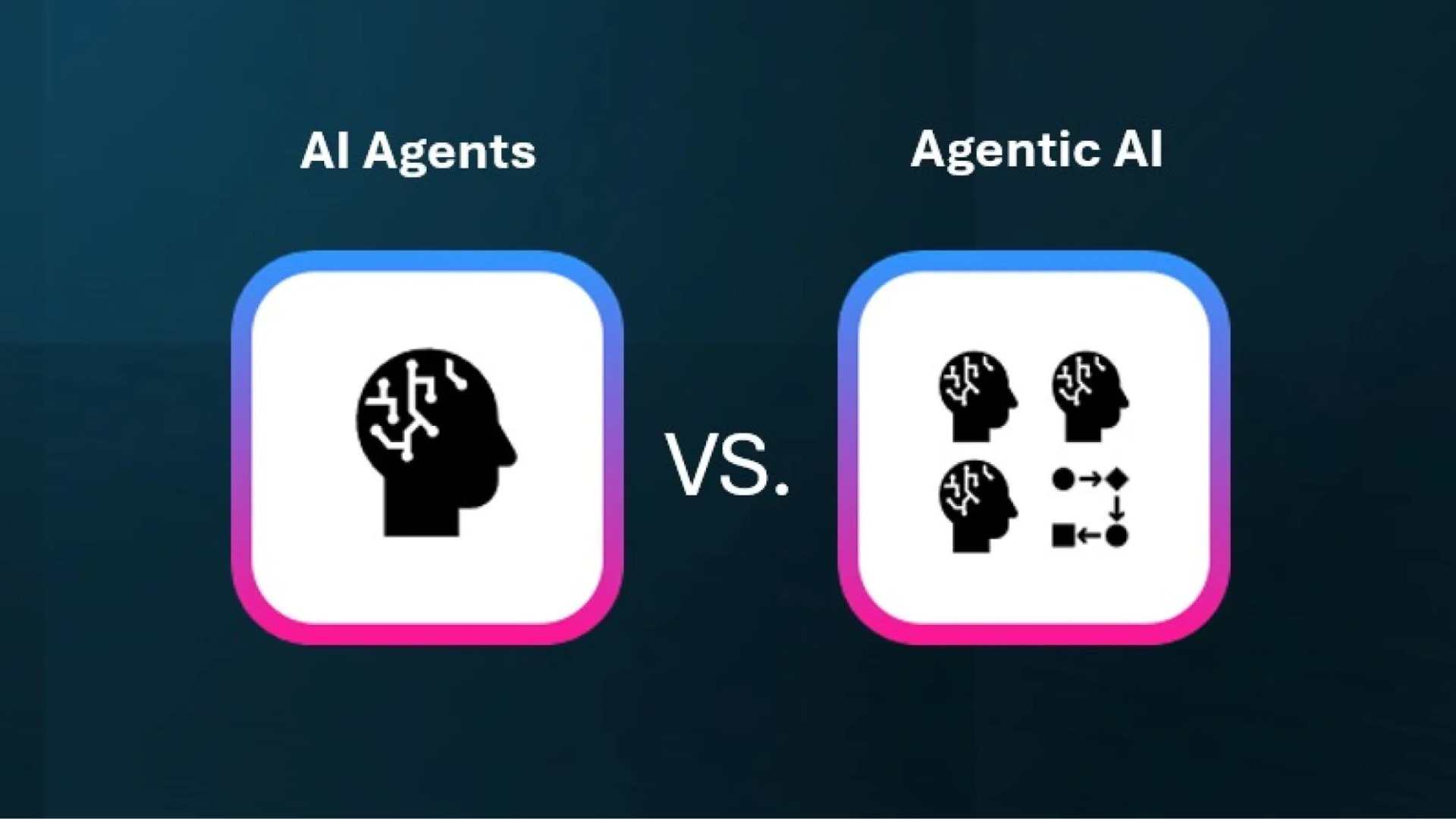
In simple terms: An AI agent usually refers to the system or component doing the work. Agentic AI describes the broader way an AI system reasons, makes decisions, and acts toward a goal. |

Agentic AI describes the broader way an AI system reasons, makes decisions, and acts toward a goal – Source: ssonetwork
3. The main difference between an AI agent and agentic AI
The simplest way to understand the difference is to look at the level of abstraction:
- An AI agent usually refers to a specific AI system or component that can perform tasks and take actions.
- Agentic AI refers more broadly to the way an AI system is designed to operate, particularly its ability to pursue goals with a degree of autonomy.
| AI agent | Agentic AI | |
|---|---|---|
| What it refers to | A specific AI system or component | A broader approach or system behavior |
| Main focus | Performing tasks and taking actions | Pursuing goals with greater autonomy |
| Scope | More specific | Broader |
| Typical capabilities | Reasoning, tool use, action execution | Planning, decision-making, adaptation, multi-step execution |
| Autonomy | Can vary from low to high | Usually emphasizes greater autonomy |
| Can involve multiple agents? | Yes | Yes |
| Example | An AI agent that checks an order and updates a ticket | A customer service system that decides how to investigate and resolve an order problem |
4. Agentic AI and AI agent solutions from PowerGate Software
For businesses, the distinction between agentic AI and AI agents matters less than understanding what the technology should actually accomplish. A practical implementation may involve a single AI agent for a focused task or a broader agentic system coordinating multiple agents, tools, data sources, and business processes.
PowerGate Software develops custom AI agent and agentic AI solutions based on the workflow, level of autonomy, integrations, and oversight a business requires.
6.1. AI strategy and agent architecture
The process can start with identifying workflows where AI agents can provide meaningful value, followed by defining goals, permissions, tools, and human oversight. PowerGate Software can design agent architectures using technologies such as LLMs, RAG pipelines, vector databases, and agent frameworks including LangGraph, CrewAI, and AutoGen.
The architecture can define:
- Agent roles and responsibilities
- Available tools and APIs
- Knowledge and memory sources
- Decision-making logic
- Human approval points
- Monitoring and evaluation mechanisms
Read more: Empowers businesses with PowerGate Software’s agentic AI solutions for scalable autonomy
4.2. AI agent development and integration
PowerGate Software builds custom AI agents that can interact with existing business systems rather than operating as isolated chat interfaces. Depending on the use case, agents can support:
- Natural language interactions
- Document and data analysis
- Multi-step task execution
- Dynamic tool and API calling
- CRM, ERP, helpdesk, and internal system integration
- Context and knowledge retrieval through RAG
For more complex use cases, multiple agents can also be orchestrated to handle different roles within the same process.
Read more: Unlock business efficiency with AI agents by PowerGate Software
5. FAQ
5.1 Are all AI agents agentic?
Not necessarily. An AI agent can have limited autonomy and operate within a relatively narrow set of predefined steps. The term “agentic” generally places more emphasis on the system’s ability to independently plan, make decisions, take multiple actions, and adapt while pursuing a goal.
In practice, there is a spectrum rather than a strict boundary. The more important question is how much autonomy the agent actually has, rather than whether a product is labeled an “AI agent.”
5.2 How can you tell if an AI system is truly agentic?
Look beyond the label and examine how the system operates. Ask whether it can define or interpret a goal, plan multiple steps, choose tools, make decisions based on context, respond to the results of its actions, and adjust its approach when something unexpected happens.
A system that simply follows a fixed workflow with an LLM added to it may be AI-powered, but that alone does not make it highly agentic. The degree of autonomy and decision-making is what matters.
5.3. Why do AI agents and Agentic AI overlap?
An AI agent can be designed to behave in an agentic way, while a larger agentic AI system can include one or more AI agents working together. This is why the two terms are often used interchangeably. They are not competing types of technology; rather, an AI agent usually describes the component, while agentic AI describes the broader behavior or architecture around it.
The difference between agentic AI and AI agents is less about two competing technologies and more about two different ways of describing AI systems. An AI agent is typically a specific system that can reason and act, while agentic AI describes a broader approach in which AI can pursue goals with greater autonomy. As AI systems become more capable, these concepts will continue to overlap, so understanding what a system actually does is more useful than relying on the label alone.