In today’s hyper-competitive digital landscape, startups and product-driven businesses face the paradox of speed: the pressure to launch fast versus the necessity of delivering meaningful value. Speed is a catalyst, but quality is the anchor. Balancing these two is the definitive challenge of modern engineering. This is why the concepts of MVP (Minimum Viable Product) and MLP (Minimum Lovable Product) have moved from buzzwords to central pillars of product strategy.
This article clarifies the practical differences between MVP and MLP, providing a framework to help you determine which approach aligns with your business stage, market maturity, and long-term scaling objectives.
1. What is an MVP (Minimum Viable Product)?
1.1. Definition of MVP
An MVP is the core-functional version of a product designed for rapid market entry. It integrates only the essential features required to solve a primary pain point and validate the fundamental business hypothesis.
The primary objective of an MVP is Validation. It seeks to answer the critical question: “Is there a genuine market demand for this solution?” By prioritizing learning over polish, teams use MVPs to minimize wasteful development and gather empirical data from real users.
Strategic MVP examples include:
- Concierge MVP: A manual process behind the scenes that mimics an automated service to test demand.
- High-fidelity prototypes: Interactive flows used to secure early-stage funding or stakeholder buy-in.
- Single-feature apps: Digital solutions that solve exactly one problem exceptionally well before expanding.
1.2. Core characteristics of MVP
A strategic MVP is defined by four pillars:
- Functional focus: Development is stripped down to the “must-haves.” Any feature not contributing to immediate validation is deferred to the backlog. Optimized time-to-market: Speed is the priority to prevent building in a vacuum. Early deployment ensures that the feedback loop starts immediately.
- Capital efficiency: By limiting scope, teams control burn rates and reduce the financial risk of market rejection.
- Data-driven iteration: Success is measured by learning milestones, usage patterns, drop-off rates, and user feedback, rather than aesthetic perfection.
1.3. When should you build an MVP?
An MVP is the optimal choice when uncertainty is high. It is best suited for early-stage startups defining their business model or for established enterprises exploring “Blue Ocean” markets where user behavior is yet to be proven. If your primary goal is to de-risk the investment, start with an MVP.
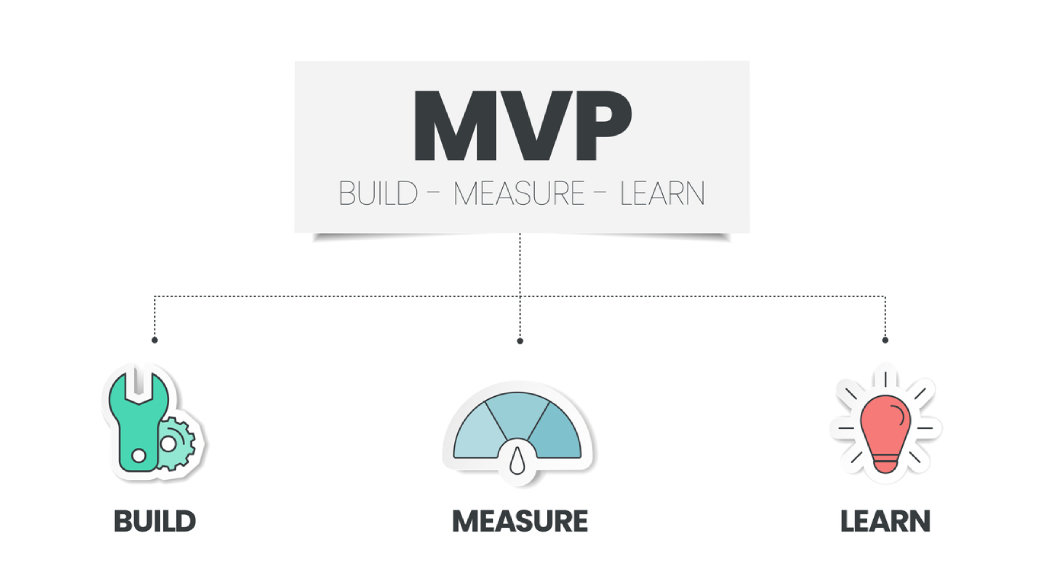
An MVP is a basic product built to quickly validate a core business idea – Source: leanstartup.co
2. What is an MLP (Minimum Lovable Product)?
2.1. Definition of MLP
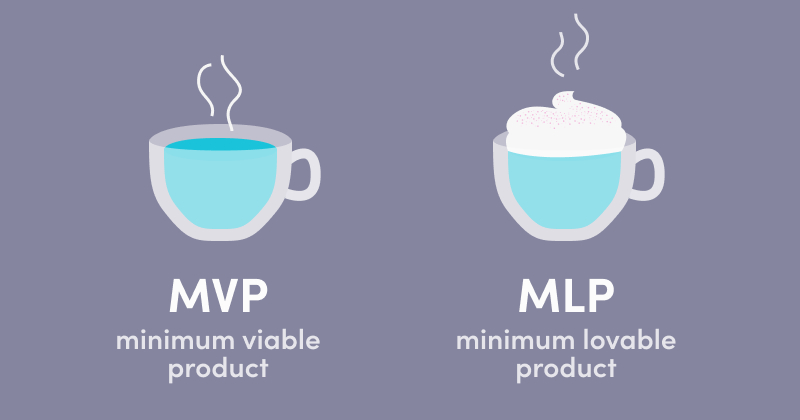
An MLP transcends basic utility. It is a product that not only functions effectively but also creates an emotional resonance with its users. The goal of an MLP is Advocacy. Beyond mere validation, it aims to deliver a “Delightful” experience that fosters immediate user loyalty. An MLP addresses the psychological layer of the user journey, making the user feel: “This product understands me. I want to integrate this into my daily life.”
Strategic MLP examples include:
- Seamless onboarding: UX flows that reduce cognitive load and lead users to the “Aha!” moment instantly.
- Brand-led interfaces: Polished UI and micro-interactions that communicate reliability and premium quality.
- Community-centric features: Early-stage personalization that makes users feel like part of an exclusive group.
2.2. Core characteristics of MLP
MLPs shift the focus from “Will it work?” to “Will they stay?”:
- UX/UI excellence: Design is treated as a core value proposition, not a cosmetic layer.
- High emotional quotient (EQ): Every touchpoint is engineered to reduce friction and evoke positive sentiment.
- The “Wow” factor: Subtle refinements, such as haptic feedback, elegant animations, or smart defaults, that differentiate the product from generic competitors.
- Retention focus: By delivering delight from day one, MLPs typically see higher organic growth and lower churn rates.
2.3. When Should You Build an MLP?
An MLP is essential in mature, competitive markets. When users have multiple functional alternatives (e.g., Fintech or Edtech), simple viability is no longer enough; experience becomes the primary differentiator. If your core problem-solution fit is already validated, an MLP is your weapon for market penetration and brand authority.
3. Key differences between MVP and MLP
While both focus on “Minimum” versions, their strategic intent creates a clear divide:
| Criteria | MVP | MLP |
| Primary goal | Validate core assumptions | Drive user delight & advocacy |
| Market risk | Building something no one wants | High cost with unproven logic |
| Focus | Functionality & reliability | Usability & delight |
| Market context | New/Emerging markets | Saturated/Competitive markets |
| User emotion | Neutral (Functional) | Positive (Emotional Connection) |
| Capital goal | Resource preservation | High LTV (Lifetime Value) |
4. When to choose MVP & when to choose MLP?
Choosing between these frameworks depends on your risk-to-reward ratio:
Choose MVP if you are testing a disruptive idea with limited data. It allows you to “fail fast” or “pivot early” without exhausting your capital.
Choose MLP if you are entering a market where the baseline for user experience is already high. In 2026, a “clunky” MVP can often damage a brand’s reputation before it even starts.
Ask yourself:
- Is the problem I’m solving already well-understood by the market?
- What is the “minimum bar” of quality expected by my target audience?
- Do I need to prove technology or emotional appeal?
Source: productschool.com
5. Can you combine MVP and MLP?
In the real world, the most successful products follow a Hybrid evolution. They don’t sacrifice logic for beauty, nor do they ignore design for the sake of speed. This approach balances Capital efficiency with User retention.
Roadmap:
- Phase 1: Validation (MVP): Deploy a functional core to prove the business model. Measure Willingness to Pay (WTP) and core engagement.
- Phase 2: Optimization (UX): Use data from Phase 1 to refine the user journey. Remove friction points that hinder the “Aha!” moment.
- Phase 3: Emotional scaling (MLP): Layer in the “Lovable” elements: branding, personalization, and polished UI to turn early adopters into brand ambassadors.
At the senior level, we recognize that frameworks should serve the business, not the other way around. A Fintech app handling life savings requires a higher level of “Lovability” (Trust/UI) than a simple internal productivity tool.
The right question isn’t “Should we build an MVP or MLP?” but rather “What is the minimum level of delight required to achieve our next business milestone?” When strategy leads, the framework becomes a roadmap to success.
|
At PowerGate Software, we don’t just write code, but we engineer success. We act as your Strategic technology partner, helping you navigate the delicate balance between speed and quality. Our holistic approach ensures that whether you are launching an MVP for validation or an MLP for market dominance, your product is built on a foundation of scalability and user-centricity. Our expertise includes:
With a track record of supporting global startups and enterprises, PowerGate Software adapts our process to your specific growth stage. Would you like a customized Product Roadmap for your vision? Contact PowerGate Software today for a 1-on-1 consultation with our product experts. |
MVP helps you learn. MLP helps you lead. There is no universal formula, only the right strategy for your specific market reality. When your product roadmap reflects a deep understanding of your users’ needs and your business’s capacity, both MVP and MLP become powerful tools for growth.