
Mental healthcare is increasingly supported by digital platforms that make care more accessible beyond the traditional therapy room. A mental health telehealth platform can connect patients with practitioners while also supporting communication, digital activities, and ongoing engagement between sessions. In this guide, we explore the key features, benefits, technology considerations, and development process behind these platforms, with practical insights from PowerGate Software’s experience building a digital mental health platform for an Australian healthcare company.
1. What is a mental health telehealth platform?
A mental health telehealth platform is a digital system that enables patients and mental health professionals to access or deliver care remotely. Depending on its scope, the platform may support therapy, psychiatric services, assessments, patient communication, digital interventions, and ongoing monitoring. A typical platform can include three main user groups:
- Patients or clients: access care, communicate with practitioners, complete activities, and track their progress.
- Practitioners: manage clients, provide guidance, review information, and assign activities.
- Administrators: manage users, staff, subscriptions, content, and platform operations.
It is also useful to distinguish telehealth from digital mental health more broadly. Telehealth usually refers to healthcare delivered remotely, while a digital mental health platform can include additional tools that support patients outside formal appointments.
For example, a platform may allow a client to track their mood every day, complete digital homework, read psychoeducation content, and communicate with a practitioner between sessions. These functions can become an important part of the overall care experience.

Source: modernhealthcare
2. 3 Key features of a mental health telehealth platform
The exact feature set depends on the clinical model and target market. Still, several capabilities are commonly important when designing a platform.
2.1. Patient and client management
The patient-facing experience should make it easy for users to access the support they need without unnecessary complexity. Common features include:
- User registration and profile management
- Appointment booking and reminders
- Secure messaging
- Access to care plans or assigned activities
- Mood and symptom tracking
- Educational resources
- Notifications and follow-up activities
For mental health products, usability matters particularly because users may already be dealing with stress, anxiety, or other difficulties. A complicated interface can become another barrier to engagement.
2.2. Practitioner tools
Practitioners need more than a video call interface. A useful platform should support their day-to-day workflow and reduce repetitive administrative work. Depending on the product, this may include:
- Client invitations and onboarding
- Client profiles and activity history
- Appointment and availability management
- Digital homework or activity assignment
- Secure client communication
- Progress and mood monitoring
- Content management
- Notes and care-related documentation
In one Australian digital mental health project, PowerGate Software built practitioner functionality that allowed clinicians to invite clients, assign digital homework, communicate through chat, and manage subscription plans. This reflected a broader product principle: the practitioner workflow needs to be considered alongside the patient experience rather than added later.
2.3. Administrative functions
Administrators typically need a separate dashboard to manage the platform at an operational level. Features can include staff and client management, subscription management, content administration, permissions, and reporting.
Separating administrative functions from clinical workflows can also help keep the practitioner interface focused. The right structure depends on the size and operating model of the healthcare business.
3. Benefits of a mental health telehealth platform
3.1. Easier access to mental health support
Remote care can reduce some practical barriers associated with traditional appointments. Patients may be able to communicate with practitioners without travelling to a clinic, which can be useful for people in remote areas or those with demanding schedules.
However, telehealth is not suitable for every situation. Some patients may require in-person assessment or emergency support, so a platform should be designed as part of a broader care model rather than treated as a replacement for all face-to-face services.
3.2. Better engagement between sessions
One of the more valuable roles of a digital mental health platform is supporting patients between appointments. A therapy session may last only a limited amount of time. A platform can provide structured activities that continue the care process, such as mood tracking, homework, educational materials, or communication with a practitioner.
PowerGate Software experienced this directly while developing a digital mental health platform for an Australian client. The product was designed to bridge the gap between therapy sessions through features such as daily mood tracking, digital homework, psychoeducation articles, and practitioner-client chat.
This approach changes the role of the platform. It is not simply a tool for holding remote appointments; it becomes part of the patient’s ongoing interaction with their care team.
3.3. Reduced administrative workload
Automation can also help practitioners and administrators handle repetitive tasks. For example, digital homework can be assigned through the platform instead of relying on separate tools or manual follow-ups.
The potential benefit is not just saving time. Keeping relevant information and activities in one system can make the overall workflow easier to manage.
4. AI in mental health telehealth platforms
AI can play a practical role in a mental health telehealth platform, especially when used to support patients between sessions. One of the most common applications is AI-powered mental health chatbot development, which can provide conversational support, answer common questions, guide users through self-help activities, and help them find relevant resources at any time. These chatbots can also support initial information gathering and engagement before or after a session, while practitioners remain responsible for clinical decisions.
Other potential AI applications include:
- Personalised educational content
- Automated reminders and engagement
- Analysis of user-reported mood or behavioural patterns
- Practitioner assistance with administrative tasks
- Initial screening and information gathering
- Identifying situations that may require human intervention
The key consideration is clinical oversight. An AI chatbot should not be positioned as a replacement for a qualified mental health professional, particularly when users may disclose distress, self-harm, or other high-risk situations. A well-designed system should define what the chatbot can handle, when it should escalate a conversation to a practitioner or appropriate support service, and how sensitive information is protected.
For healthcare product teams, this means AI should be designed around the clinical workflow rather than added as a standalone feature. PowerGate Software can support AI-powered mental health chatbot development as part of a broader digital health platform, combining conversational AI with secure patient experiences and practitioner workflows.
5. Technology considerations
A mental health telehealth platform usually combines several components rather than relying on a single application.
5.1. Mobile and web applications
Patients may primarily use a mobile application, while practitioners may prefer a web-based dashboard for managing multiple clients.
In PowerGate Software’s Australian project, the mobile application was developed with React Native, while the web application used React.js and Node.js on the backend. The four-person team covered software development, solution architecture, UX/UI design, QA, and project management.
The choice of technology should depend on the product’s requirements, existing systems, team capabilities, and expected scale. There is no single technology stack that is correct for every healthcare platform.
5.2. Secure data architecture
Mental health platforms handle highly sensitive information, including personal details, communication, assessment results, and potentially clinical records. Security therefore needs to be considered from the architecture stage. Important areas include:
- Strong authentication and authorisation
- Role-based access control
- Encryption in transit and at rest
- Secure data storage
- Audit logging
- Consent management
- Secure API design
- Appropriate backup and recovery processes
Regional requirements should also be reviewed before development begins. A platform serving Australian users, for example, may have different privacy and data-handling requirements from one designed for the US or European markets.
Looking for a partner for your mental health telehealth platform? Read our article: Top 5 software development partners to build your mental health platform
6. How to build a mental health telehealth platform
6.1. Start with user and workflow research
Before writing code, define how patients, practitioners, and administrators will actually use the platform.
This includes mapping onboarding, care delivery, communication, activities, follow-up, and administrative processes. PowerGate applies this approach by first examining user needs and workflows before moving into product design and architecture.
6.2. Design the core experience
UX/UI design should focus on reducing friction. For patients, this may mean simple navigation and clear actions. For practitioners, it may mean fast access to client information and straightforward activity management.
In mental health products, tone and accessibility also matter. The interface should feel clear and supportive without becoming distracting or overly clinical.
6.3. Build and test
The first version should focus on the workflows that are essential to the care model. Depending on the product, this could include patient onboarding, practitioner management, messaging, digital activities, and basic monitoring.
Testing should cover not only functionality but also permissions, data security, usability, and edge cases. Healthcare software requires particular attention to what happens when users provide incomplete information, lose connectivity, or access the platform from different devices.
6.4. Deploy and continue improving
Launching the first version is not the end of product development. User feedback, practitioner needs, new clinical workflows, and regulatory requirements may all lead to future changes.
In the Australian project, PowerGate Software helped launch the product from scratch in four months, covering UX/UI design, development, and delivery before transitioning the product to the client’s internal team for continued operation and growth.
7. Final considerations when developing a mental health telehealth platform
Building a mental health telehealth platform requires a balance between clinical needs, user experience, security, and technical practicality. The most useful platforms are not necessarily those with the largest number of features. They are the ones that fit naturally into how patients receive support and how practitioners deliver care.
A real-world project also shows why this work needs to start with the workflow rather than the technology. PowerGate Software’s experience building a digital mental health platform for an Australian healthcare company demonstrates how patient engagement, practitioner tools, secure architecture, and mobile and web experiences can be brought together in one product.
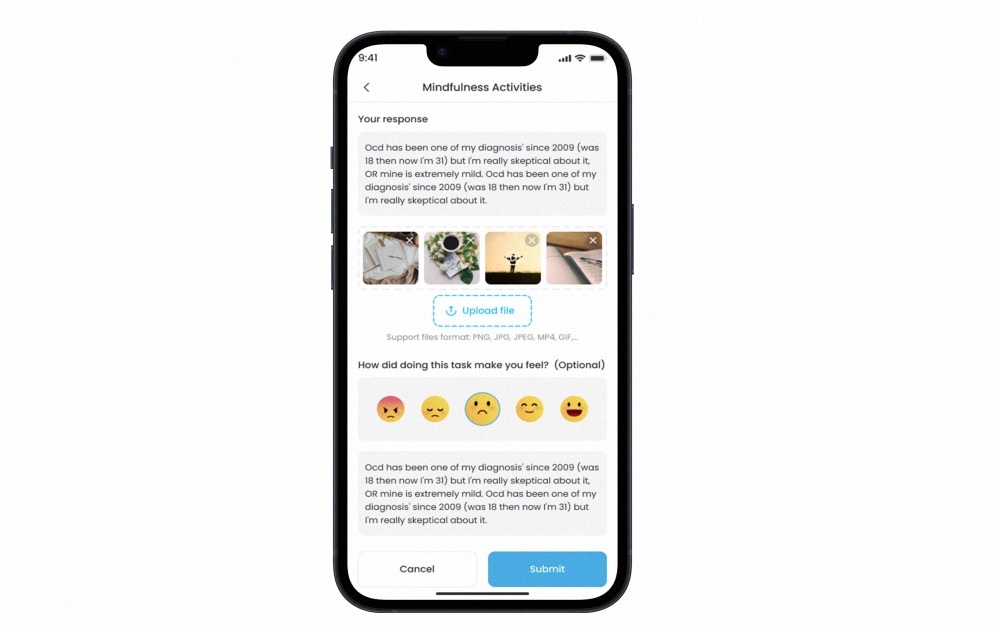
PowerGate Software’s mental health telehealth platform for an Australian partner
A mental health telehealth platform can do more than enable remote consultations. With the right design, it can help patients stay engaged between sessions, give practitioners practical tools for ongoing support, and create a more connected digital care experience. For healthcare companies planning such a product, understanding the clinical workflow, security requirements, user needs, and technology choices early can make the difference between simply launching an app and building a platform that people can use effectively over time.
Have an idea for a mental health telehealth platform? Talk to PowerGate Software’s healthcare software experts to explore your idea, define the right features, and turn it into a secure, practical digital product!