
Choosing the right software development partner is one of the most critical decisions in any digital project. Whether you are building a new product or scaling an existing system, the success of your initiative depends heavily on who you work with. This guide from PowerGate Software walks through a practical, real-world approach to choosing a software development partner that actually fits your business.
1. Start with clarity, not vendor research
Most companies make the same mistake at the beginning. They jump straight into searching for vendors without clearly defining what they need. That usually leads to a long list of agencies that all look similar on paper but fail to deliver in practice. Before you evaluate any partner, you need to answer the following 5 basic questions:
- Are you building a product from scratch or improving an existing one?
- What is your expected timeline and budget range?
- Do you need a full team or just specific roles?
- What technologies are involved?
- Which industry are you operating in?
This step is not about writing a perfect specification. It is about creating enough clarity so that you can filter out irrelevant vendors early. For example, a company that specializes in AI solutions may not be the right choice if your goal is to implement a simple internal management system.
2. Use multiple sources to build your initial list
Relying on a single source to find a software development partner is risky. Each platform has its own bias, and no single channel gives you the full picture. A more reliable approach is to combine different sources:
- Review platforms such as Clutch, GoodFirms, DesignRush, The Manifest, and UpCity provide structured comparisons, including client feedback, pricing ranges, and service focus. These platforms allow you to filter vendors by location, expertise, hourly rate, and verified client reviews, which helps you quickly build an initial comparison set.
- Search engines help you discover companies that are actively investing in thought leadership and SEO. Vendors that consistently publish high-quality content often have stronger positioning, clearer service offerings, and a more mature go-to-market strategy.
- LinkedIn gives you insight into team size, hiring trends, and company activity. For example, a company that is actively hiring engineers in your tech stack may indicate growth and available capacity. You can also review employee profiles to validate technical depth.
- Company websites showcase case studies and technical capabilities. This is where you evaluate how a vendor presents its past work, the industries it serves, and the complexity of projects it has handled.
- AI-powered research tools like ChatGPT, Perplexity, Gemine… can help you quickly generate initial shortlists, compare vendors, or summarize market options based on specific criteria. However, they should be used as a starting point rather than a final source of truth. The value lies in speed and synthesis, but the outputs still need to be verified through primary sources such as case studies, client reviews, and direct conversations. At this stage, your goal is not to find the best partner. It is to create a long list of potential candidates, usually around 15 to 20 companies.
This multi-source approach reduces bias and gives you a more balanced, realistic view of the market before moving into deeper evaluation.
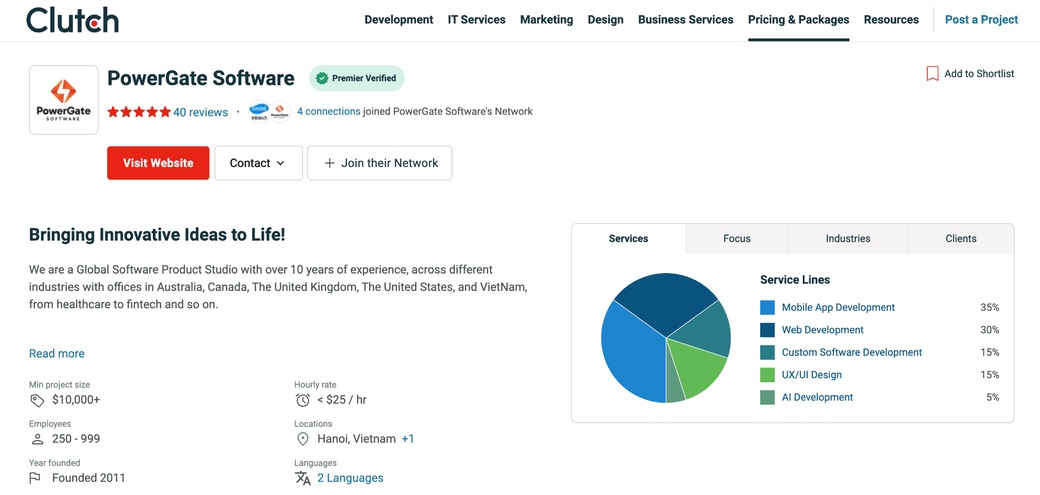
Platforms like Clutch offer a quick, structured overview of a software development partner’s capabilities and client feedback
3. Apply hard filters to narrow down the list
Once you have a broad list, the next step is to eliminate companies that clearly do not fit your requirements. This is where hard criteria come in. Focus on factors that are easy to verify:
- Industry experience: Have they worked in your domain before?
- Team size and structure: Can they handle your project scale?
- Technical expertise: Do they have proven experience with your required technologies?
- Communication capability: Can they work effectively in your language and time zone?
- Service model: Do they offer dedicated teams, project-based delivery, or both?
This step should reduce your list significantly, often down to 8 to 12 companies. The goal here is efficiency. You are not judging quality yet. You are simply removing obvious mismatches.
>>> Looking for a Vietnamese software development partner? Refer to the top-rated software companies in Vietnam!
4. Look beyond ratings and dig into real evidence
At this point, many businesses rely too heavily on ratings and testimonials. That is a mistake. High ratings do not always mean high quality, and low ratings do not always mean poor performance. Instead of focusing on numbers, look at the details behind them. When reviewing client feedback, pay attention to patterns:
- Do clients consistently mention strong communication?
- Are there comments about missed deadlines or unclear processes?
- Is the feedback specific or generic?
The same applies to case studies. If a case study only describes features without context, it is likely more marketing than substance. A strong case study should clearly explain:
- The problem the client faced
- The solution that was implemented
- The measurable impact of that solution
Beyond reviews and case studies, certifications can provide an additional layer of validation. Standards such as ISO 9001 and ISO 27001 indicate that a company follows structured processes and has been independently audited. This is particularly important for projects that involve sensitive data or require consistent delivery quality.
However, certifications should not be treated as a deciding factor on their own. They are a signal of operational maturity, not proof of real-world performance. A partner with strong domain experience and proven results may still be a better fit than one with multiple certifications but limited practical expertise.
This stage requires careful reading, but it is where you start to separate average vendors from serious partners.
Source: proqc.com
6. Evaluate how they think, not just what they deliver
A reliable software development partner does not simply follow instructions. They challenge assumptions, ask questions, and contribute ideas. One of the best ways to assess this is through early conversations. Pay attention to how they respond when you present your project:
- Do they ask thoughtful questions about your business goals?
- Do they suggest alternative approaches or improvements?
- Do they identify potential risks early?
If a company immediately agrees with everything you say, that is not a good sign. It often means they are focused on closing the deal rather than delivering the best outcome. Strong partners bring a product mindset. They think about user experience, scalability, and long-term value, not just implementation.
7. Understand their delivery process
Even highly skilled teams can fail without a clear and structured delivery process. That is why it is important to understand how your potential partner works. 4 key aspects to evaluate include:
- Development methodology: Do they practically follow Agile practices?
- Communication rhythm: How often will you receive updates?
- Quality assurance: What testing processes are in place?
- Project management tools: How is progress tracked and shared?
Do not settle for vague answers. Ask for specifics. A mature team should be able to clearly explain how they plan, execute, and deliver projects. This step helps you avoid one of the most common issues in outsourcing: lack of transparency.
8. Shortlist based on fit, not popularity
After evaluation, you should narrow your list down to three to five companies. At this stage, the goal is not to pick the most famous or highest-rated option. Instead, focus on fit. Each partner should have a clear reason why they are on your shortlist. For example:
- One may offer the best cost-to-quality balance
- Another may have deep expertise in your industry
- A third may stand out for its strong technical leadership
This approach gives you flexibility. It allows you to compare different strengths rather than choosing between similar profiles.
9. Validate through real interaction
Before making a final decision, you need direct interaction with your shortlisted partners. This is where many hidden issues surface. Consider the following 3 steps:
- Request a proposal or initial project plan
- Schedule a discovery call with the core team
- Discuss a small pilot project, if possible
During these interactions, observe carefully:
- How well do they understand your requirements?
- How clear and structured are their proposals?
- How responsive and transparent is their communication?
This phase often reveals more than all previous research combined. A strong partner will demonstrate both technical competence and a collaborative mindset.
Watch for common red flags
While evaluating partners, there are a few warning signs you should not ignore:
- Overpromising unrealistic timelines or results
- Lack of detailed case studies or verifiable experience
- Poor communication during early discussions
- Reluctance to discuss risks or challenges
- Generic proposals that do not address your specific needs
These signals usually indicate deeper issues that may affect your project later. It is better to walk away early than deal with costly problems down the line.
Choosing a software development partner is not about finding the biggest name or the lowest price. It is about finding a team that understands your goals, communicates clearly, and can deliver consistently over time. By following a structured approach, from defining your needs to validating real collaboration, you can significantly increase your chances of success. In the end, the right software development partner is not just a vendor, but a long-term contributor to your business growth.
| If you are looking for a reliable software development partner, PowerGate Software is worth considering. Established in 2011, the company combines a strong product mindset with internationally recognized standards such as ISO 27001:2022 and ISO 9001:2015. PowerGate Software has delivered solutions for clients across Australia, Asia, and North America, supported by a distributed team of experts from different parts of the world. This blend of global experience and structured delivery makes them a practical choice for businesses that need both technical capability and long-term thinking. >>> Contact PowerGate Software today to discuss your idea! |